
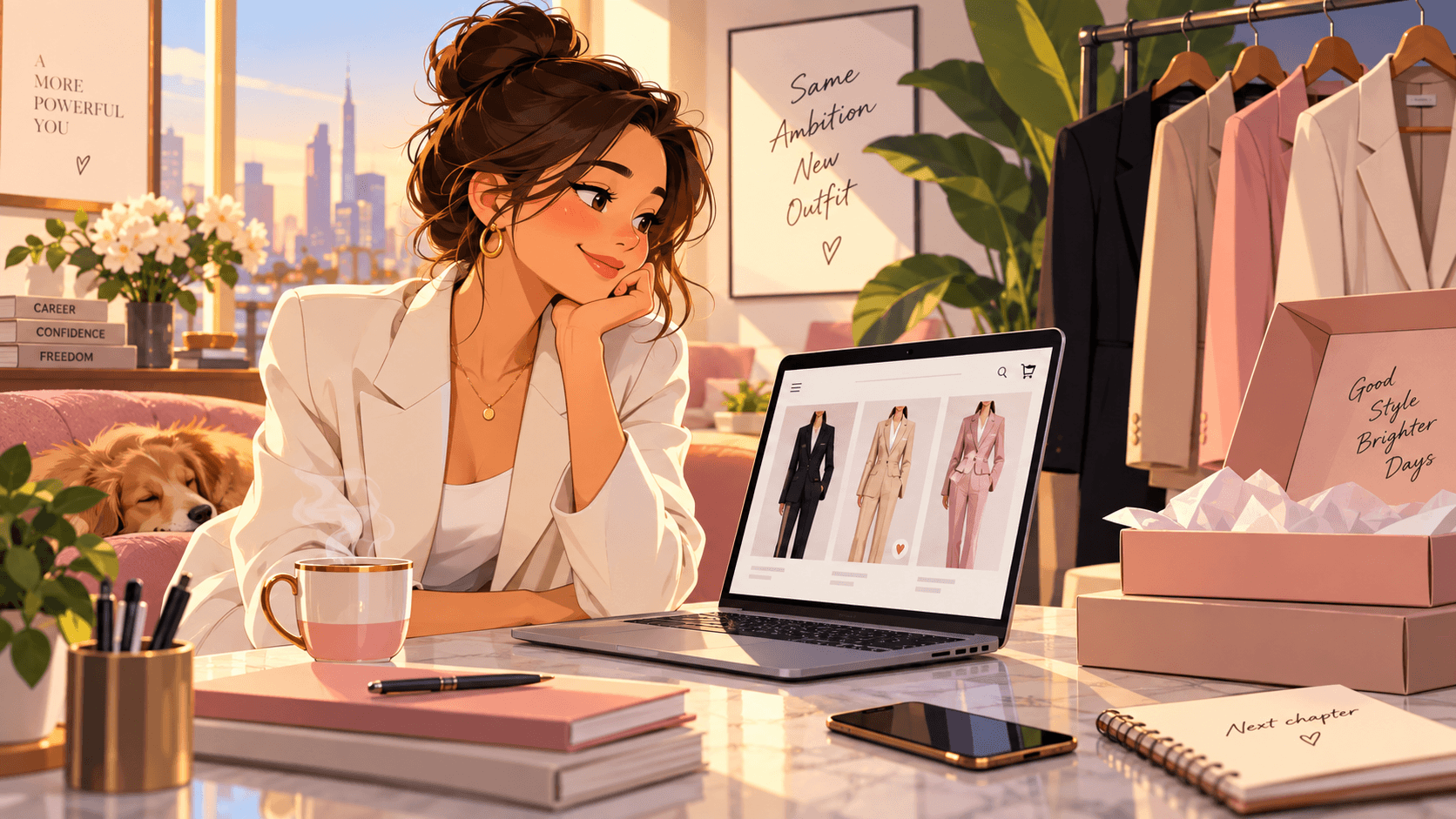
A product photo can make almost any suit look expensive. The model stands at the right angle, the jacket is clipped at the back, the trousers were steamed minutes before the shot and the lighting flatters the cloth. You only find out what you actually bought when the parcel arrives and you fasten the button in front of your own mirror.
That is no reason to avoid it. When you buy a women’s suit online from a good store, you often get more useful detail than a busy shop floor offers: the full fabric composition, garment measurements for every size, fit notes and sometimes free body shape and colour quizzes. The photo just has to become the start of your research instead of the whole of it.
The short version: read the fabric label before you trust the photo, match the shoulder measurement before the size label, favour stores that sell jackets and trousers as separates, and read the returns page before you pay. The seven checks below show what good looks like for each, followed by a size conversion chart, a quick way to vet the store itself and a guide to what a tailor can and cannot fix.
Consumer rules in this guide were last checked against the EU’s Your Europe returns guidance and the FTC’s Mail, Internet, or Telephone Order Merchandise Rule on [date].
Table of contents
- Why buying a suit online feels harder than buying a jumper
- The 7 checks at a glance
- 1. Start with the fabric, not the photograph
- 2. Look closely at the cut and construction
- 3. Check that the store offers more than one silhouette
- 4. Use body shape guidance to choose a cut you have not tried on
- 5. Look beyond black, navy and grey
- 6. Trust the size guide more than the size label
- 7. Check delivery, returns, payment and advice before you pay
- How to vet an online suit store in five minutes
- Women’s suit alterations: what a tailor can fix after delivery (and what they can’t)
- Why a premium women’s suit often costs less per wear
- Sizing, fabric, alterations and returns: quick answers
Why buying a suit online feels harder than buying a jumper
A jumper forgives a lot. Knitwear stretches, a relaxed shape hides small differences in size, and long sleeves can be pushed up. Tailoring has no such slack. A jacket has to fit your shoulders, bust, waist, back length and arm length at once, and trousers have to agree with your waist, hips, seat, rise and inside leg. A couple of centimetres in the wrong place changes the whole look.
Fabric is the second problem. On a screen you cannot feel the weight of the cloth or check whether it recovers after an hour at your desk, and two navy suits can look identical in photos yet feel completely different in person. A suit also costs more than most garments, so a mistake is expensive in money and in time.
The better places to buy women’s suits online fill those gaps with information. Look at how luxury brands present expensive products online and the same habits keep appearing: close-up photos of the material, specifications you can actually find and very little fake urgency. One flattering photo, a vague line about “premium fabric” and a countdown timer should make you more cautious, not less.
The 7 checks at a glance
| What to check | Good signs | Warning signs |
|---|---|---|
| 1. Fabric | Full composition in percentages, natural fibres (ideally wool), weight or season stated | “Premium fabric” with no details, mostly synthetic cloth at a premium price |
| 2. Cut and construction | Details on shoulders, lining and finishing, photos from the back and side | Styling adjectives only, a single front-facing photo |
| 3. Choice of silhouettes | Several jacket and trouser shapes, sold as separates | One cut presented as the fit for everyone |
| 4. Body shape guidance | An online body shape quiz and fit notes on each product | No explanation of how a cut sits on the body |
| 5. Colour | A range beyond black, navy and grey, a colour analysis tool, daylight photos | One studio shot per colour and vague colour names |
| 6. Sizing information | Garment measurements, the model’s height and size, fit notes | A generic S, M, L chart and nothing else |
| 7. Delivery, returns, payment and advice | Clear costs, a stated return window and exclusions, secure payment, reachable advisers | Refunds as store credit only, terms that appear only at checkout |
1. Start with the fabric, not the photograph
Fabric is one of the first honest indicators of quality, because clever cutting cannot fix it. The cloth decides how a suit drapes, how warm it feels, how quickly it creases and how it looks after its fiftieth wear. Natural fibres generally age better than synthetics, and for a suit that looks beautiful and lasts, wool is the benchmark.
What wool does better than polyester
Wool fibres have a natural crimp that gives the cloth elasticity, so a good wool suit recovers when you stand up after a long meeting. It takes a press well, which lets a maker shape it around the chest and shoulders, and it breathes in a way polyester does not. Heavily synthetic suits tend to trap heat, turn shiny where they have been pressed and pill under the arms and between the thighs.
Not every blend is a problem. A few percent of elastane makes tailored trousers more comfortable, and wool mixed with a little silk, mohair or linen can be excellent. Be wary of a suit priced as a premium piece whose label is mostly polyester, or a description that avoids percentages altogether.
Why wool works in summer too
Many shoppers skip wool in spring because they picture a thick jumper. Suiting wool is a different material, spun into fine yarns and often woven into light, open cloths. Merino wool absorbs and releases moisture vapour quickly, which is why lightweight wool can be worn comfortably in summer when the weight and weave are right.
Weight is the figure to look for. As a rough guide, cloth under about 250 grams per metre suits warm weather, 250 to 300 grams covers most of the year in an office, and heavier cloths such as flannel belong to autumn and winter. If a store quotes grams per square metre instead, expect lower numbers for the same cloth. Add a cupro or viscose lining, or choose a half-lined jacket, and a mid-weight wool suit can realistically carry you through three seasons.
Why Italian wool has earned its reputation
Italian mills, particularly around Biella in Piedmont, have been weaving fine wool for centuries, and their cloth is known for consistent quality, a soft handle and a fluid drape. That drape is what makes an Italian wool women’s suit look relaxed and precise at once. The jacket falls cleanly and the trousers move with you instead of holding stiff creases.
Read the wording, though. “Italian wool” or “fabric woven in Italy” usually means an Italian mill made the cloth, while the fibre itself often comes from Merino sheep raised in Australia. “Made in Italy” describes where the garment was made. Both can signal quality, but they are different claims.
You may also see a Super number, such as Super 110s or Super 120s. It describes the fineness of the wool fibres, and the higher the number, the finer and softer the cloth. For a suit you will wear every week, Super 100s to 130s is a sensible range, since much finer wools crease more easily and wear faster at the elbows and seat.
Read the product description like a tailor
A reliable description lists the exact composition of the outer fabric and the lining, the origin of the cloth, its weight or season and the care instructions. Better stores add fit notes and construction details. Words such as “luxurious” cost nothing to write, whereas percentages, weights and origins require real knowledge of the product. If a detail you care about is missing, ask before ordering. A store that knows its fabrics will answer quickly.
2. Look closely at the cut and construction
It is tempting to think of a suit as a jacket and a pair of trousers that happen to share a fabric. The ones that look expensive are designed as a pair. The jacket length relates to the trouser rise, the lapel width to the shoulder and the volume of the leg to the volume of the jacket. Matching cloth is only the starting point.
Shoulders come first
The shoulders carry the whole jacket and are the hardest area for a tailor to alter. The shoulder seam should end at the edge of your shoulder bone. Too far out and the top of the sleeve collapses into dents; too far in and the sleeve pulls across your upper arm. Stores describe shoulder construction in different ways, from a structured shoulder with light padding to a soft, natural shoulder or a roped sleeve head with a slight ridge where the sleeve joins. Choose the look you like, then make the shoulder measurement your priority. The old tailoring advice still holds: buy for the shoulders and alter the rest.
Proportions, balance and drape
A well-balanced women’s suit jacket hangs level at the front and back, closes without X-shaped creases around the button and has lapels that lie flat. The button position matters more than most people expect, because it sets where the eye reads your waist. Check photos from the side and back, and if a store only shows the front, ask for more images before you commit.
Drape describes how the cloth falls from the shoulders and chest. A good jacket hangs cleanly when open and does not stand away from the body. The fibre helps here, since Merino wool absorbs moisture vapour and builds up less static, so it hangs instead of clinging. So does construction. Many ready-to-wear jackets are fused, with the interlining bonded to the cloth by heat-activated glue, which can feel stiff and occasionally bubbles after cleaning. A half-canvas front uses a stitched, floating layer through the chest that moulds to your shape over time. Few product pages say which method was used, so it is a fair question for customer service.
Trousers deserve the same attention
Well-cut tailored trousers sit at the waist without gaping at the back, show no pulling lines around the crotch, leave room in the seat to sit comfortably and have a crease that falls straight to the middle of the shoe. The rise, meaning the distance from the crotch seam to the waistband, decides whether they sit high and lengthen the leg or sit lower for a more casual look. Check whether the hems are finished or left long, and whether the back seam has extra fabric a tailor can let out later.
Finishing shows how much care went in
Zoom into the photos. On striped or checked cloth, the pattern should line up across seams and pockets. Buttonholes should be neat and dense, and the jacket lining should have a pleat at the back so you can move without straining it. Cupro and viscose linings breathe better than polyester. Working cuff buttonholes are a lovely detail, but they make sleeves harder to shorten, so if you usually have sleeves taken up, check the sleeve length first.
3. Check that the store offers more than one silhouette
A store that sells a single “universal” cut is betting that everyone’s shoulders, waist and legs relate to each other in the same way. They don’t. Specialist retailers of women’s tailoring usually offer several jacket and trouser shapes, and the most useful ones sell them as separates so you can combine cuts and sizes.
On the jacket side, a fitted single-breasted blazer defines the waist and works with almost everything. A double-breasted blazer adds structure across the chest and looks more formal, especially when buttoned. Belted jackets mark the waist more softly, and longer, relaxed blazers create a modern line over slim trousers. If the women’s blazer you like comes in only one shape, you are accepting its proportions and hoping they match yours.
Trouser shapes change the character of a women’s trouser suit even more. Cigarette trousers are slim and ankle length, clean with loafers or heels and easy to wear under a longer jacket. Straight-leg trousers fall in a line from the hip and suit almost any occasion. Wide-leg trousers, usually cut with a high rise, add movement and balance a strong shoulder, although they need hemming for the shoes you plan to wear. Flared trousers fit through the thigh and open from the knee, which lengthens the leg, particularly with a heel. One jacket paired with two trouser shapes gives you a surprising amount of women’s workwear from a single fabric.
4. Use body shape guidance to choose a cut you have not tried on
The biggest worry about buying tailoring online is choosing a silhouette without trying it first. In a shop you can take three cuts into the fitting room and compare them in minutes. Online, you have to picture each one on your own body.
Some specialists that sell women’s suits online now offer free body shape quizzes, sometimes called morphology tests, to close that gap. You enter a few measurements, usually shoulders, bust, waist and hips, or pick the outline closest to your own, and the test places you in a category, often labelled with letters such as A, V, H, X and O or with names like triangle and hourglass. The helpful part is the explanation that follows: how different jacket and trouser shapes interact with your proportions.
Those explanations rest on simple principles of line and volume. A jacket that ends at the hip bone draws a horizontal line at that point. A double-breasted front adds visual width across the chest, while a belted jacket marks the waist. Wide-leg trousers add volume below and can balance broad shoulders, flares lengthen the leg, and cigarette trousers keep the lower half narrow so the jacket creates the shape.
Treat the result as extra information, never as a rulebook. Plenty of women with a “triangle” result wear wide-leg trousers brilliantly because they love them. A test cannot see your posture, the way you move or what makes you feel like yourself, and it is only as accurate as your tape measure. Use it to build a shortlist, then make your own choice.
Editorial note: 17h10, the Paris-based tailoring label linked above, is mentioned only as an example of a store that offers a free body shape and colour quiz. Sites Gallery has no commercial relationship with the brand. Its website is in French.
5. Look beyond black, navy and grey
Physical shops have limited rail space, so they tend to stock the colours most people already buy. Online stores can offer a far wider range, and that is one of the real advantages of shopping this way. Bottle green, burgundy, cobalt blue, powder pink and chocolate brown all give you options a navy suit cannot.
These colours are more practical than they sound. Burgundy and deep brown behave almost like neutrals at work, green and mid blue look assured in a meeting, and pink works for weddings and daytime events and splits easily into separates worn with denim or knitwear. Screens and studio lighting shift colour, so look for several photos, ideally one taken in daylight, a precise colour name and fabric swatches if the store offers them.
How an online colour analysis test can help
Colour analysis looks at your natural colouring, meaning the undertone of your skin and the depth and contrast of your hair and eyes, to find the colour families that make your complexion look fresh and even. Most systems start from four seasons and refine them by asking whether your colouring is warm or cool, light or deep, clear or soft. It draws on the same theory designers use to choose a colour palette that works together: hue, depth and saturation, rather than one colour judged in isolation.
Online colour analysis tests usually ask about the veins on your wrist, whether gold or silver jewellery flatters you, and your natural hair and eye colour. Lighting, screens and hair dye all interfere, so treat the result as approximate, but it does narrow the field. A warm result might point you towards tobacco brown or olive green, and a cool one towards burgundy, cobalt or charcoal. Colour matters most in the jacket, since it sits close to your face, and a shirt in a flattering shade can bridge the gap when you love a suit colour just outside your palette.
Combine a colour result with body shape guidance and online shopping becomes far more personal, because you end up with a cut that suits your proportions in a shade that suits your colouring. That combination makes it much more likely you will still enjoy wearing the suit in five years, and a timeless wardrobe is mostly made of pieces like that.
6. Trust the size guide more than the size label
Sizing is where most online suit orders go wrong, and a generic S, M, L chart is not enough for tailoring. A proper size guide gives garment measurements for each size, such as shoulder width, chest, sleeve length, back length, trouser waist, hips, rise and inside leg. It should also state the model’s height and the size she is wearing, with fit notes like “cut close to the body” or “take your usual size”.
Size labels vary between countries and brands. A French 38 is usually a UK 10 and an Italian 42, yet one label’s 38 can be generous and another’s tight. The most reliable method is to lay a blazer and tailored trousers that already fit you well on a flat surface, measure them and compare the numbers with the store’s garment measurements. It also helps to know your own measurements, taken with a soft tape over thin clothing:
- Shoulder width, measured across your back from the edge of one shoulder bone to the other. This is the number to match most closely on a jacket.
- Bust, around the fullest part, with the tape level all the way round.
- Natural waist, at the narrowest point of your torso, plus wherever you like trousers to sit if that is higher or lower.
- Hips, around the fullest part of your hips and seat. This figure usually decides your trouser size.
- Sleeve length, from the edge of your shoulder to your wrist bone with your arm relaxed.
- Inside leg, from the crotch to where you want the hem to fall, wearing the shoes you plan to pair with the suit.
If you fall between sizes, let your shoulders and bust choose the jacket and your hips choose the trousers. Taking in a waist is simple for a tailor, but nobody can add fabric that is not there. Stores that sell separates make this easier, because your women’s suit fit no longer depends on your top half and bottom half sharing a size.
Women’s suit size conversion chart: UK, US, France, Italy and Germany
Suit labels change at every border, which is why a size you know well can arrive a size too big or too small. This chart lines up the most common women’s suit sizes across the main systems you will meet when shopping online:
| UK | US | France, Spain, Belgium | Italy | Germany, Netherlands |
|---|---|---|---|---|
| 6 | 2 | 34 | 38 | 32 |
| 8 | 4 | 36 | 40 | 34 |
| 10 | 6 | 38 | 42 | 36 |
| 12 | 8 | 40 | 44 | 38 |
| 14 | 10 | 42 | 46 | 40 |
| 16 | 12 | 44 | 48 | 42 |
| 18 | 14 | 46 | 50 | 44 |
Treat the chart as a starting point, not a verdict. It lines up labels, not bodies, and two brands can cut the same French 38 quite differently. The number that settles it is still the garment measurement: your shoulder width against the jacket’s, your hips against the trousers’. If you are around 163 cm (5’4″) or shorter, look for petite suits. The difference is in jacket length, sleeve length and trouser rise, not just a shorter hem.
When you compare the same size across several brands, a multi-brand shopping search engine such as Modalova lets you see similar cuts from different retailers side by side. Each item links through to the original store, so you still read that store’s own size guide before you order.
7. Check delivery, returns, payment and advice before you pay
Customer service matters most when the purchase is an investment. A premium women’s suit is a considered buy, and the services around it decide how easily you can fix a wrong size or a colour that looks different in daylight. Clear sizing information is the first of those services. The others deserve the same scrutiny.
Start with the delivery conditions: the cost, any free delivery threshold, the timeline and tracking. If the store is in another country, check whether duties and import taxes are included or payable on arrival, which can happen on orders between the UK and the EU. If you need the suit for a specific date, allow three to four weeks for delivery, a possible exchange and alterations.
Then read the return policy properly. In the EU, buying online gives you a 14-day cooling-off period that starts on the day of delivery, and UK rules are similar. You usually pay the return postage unless the store covers it, and goods made to order or clearly personalised, such as a tailor-made suit, are excluded. Store policies often add conditions of their own, such as free returns only within the home country, no returns on sale items or refunds as store credit. When the suit arrives, try it on with the right shoes, sit down, reach forward, check the colour in daylight and keep the tags on until you are sure.
US shoppers should know the rules work differently there. There is no general federal right to return an online purchase, so the store’s own return policy is what protects you, and it deserves a careful read before you pay. What federal law does cover is delivery. Under the FTC’s Mail, Internet, or Telephone Order Merchandise Rule, a seller must be able to ship within the time it advertises, or within 30 days if it states no time. If it can’t, it has to ask for your consent to the delay or refund you. That matters when you need a suit for a specific date.
For payment, stick to recognised methods such as bank cards and established digital wallets, which usually give you a way to dispute a charge, and avoid direct bank transfers to shops you do not know. Some stores let you split the cost into two or three instalments. That can help with budgeting, but check the fees for missed payments and how refunds work if you send the suit back.
Good stores also give you people to talk to, whether through live chat, phone, email, video consultations or boutique appointments. Test that customer advice and fit guidance before you spend anything by asking a precise question, such as the jacket’s back length in your size or whether the front is fused or canvassed. A clear answer within a day tells you a lot. The next section shows how to check who runs a store in about five minutes.
How to vet an online suit store in five minutes
Section 7 covers the store’s policies. This check covers the store itself. A convincing website is no longer proof of an established business. Most shops are built on the same few platforms and themes, which is a big part of why so many websites look the same. A small new shop can look as polished as a heritage brand for the price of a template. Specialists in tailored suits for women still leave clear signals on their site, and five minutes is enough to find them:
- Composition on the product page. Fabric percentages should sit near the price or one tap away, not buried in a PDF or missing entirely.
- A size guide for each product. Garment measurements that change from jacket to jacket suggest someone actually measured the stock. One sitewide S, M, L chart suggests nobody did.
- Photos you can’t find elsewhere. Back and side views, cloth close-ups and the same model across colours all point to a brand shooting its own products. Search a product photo with a reverse image tool: if it appears on a dozen unrelated shops, walk away.
- A company behind the footer. EU online shops have to show their legal name, a geographic address and registration details. Check that the returns address is in the same country as the company.
- Urgency that survives a reload. Countdown timers that restart on refresh, or “only 2 left” on every size, are design choices meant to rush you.
- Ad transparency. If you reached the store through a sponsored search result, open “About this advertiser.” Google shows the name and location the business confirmed during Google Ads advertiser verification, and that name should match the company in the store’s footer.
- Language and currency. If the store is based abroad or its site isn’t in your language, check that it ships to your country, shows prices in your currency and has customer service that answers in a language you are comfortable arguing a return in.
A store that passes all seven is not guaranteed to fit you perfectly, but it is very unlikely to disappear with your money.
Women’s suit alterations: what a tailor can fix after delivery (and what they can’t)
Knowing what can be altered changes how you choose a size. It is the reason the old advice says to buy for the shoulders and fix the rest. Here is how common women’s suit alterations compare:
| Alteration | How hard it is | What to know |
|---|---|---|
| Hemming trousers | Easy | Bring the shoes you will wear with the suit |
| Shortening sleeves (non-working cuffs) | Easy | Done from the cuff, buttons move up |
| Taking in the trouser waist and seat | Easy to moderate | Depends on the centre-back seam |
| Letting out the trouser waist | Moderate | Only possible if there is seam allowance, usually a couple of centimetres |
| Taking in the jacket waist | Moderate | Done through the side or back seams |
| Tapering the trouser leg | Moderate | Changes the silhouette, so pin it first |
| Shortening sleeves with working buttonholes | Hard | Often has to be done from the shoulder |
| Shortening the jacket body | Hard, rarely worth it | Pockets and buttons end up in the wrong place |
| Changing the shoulder width | Very hard, rarely worth it | The reason shoulder fit comes first |
The timing matters as much as the tailor. Most stores refuse returns on altered items, so try the suit on, get a tailor’s opinion while the tags are still attached, and only book the work once you are sure you are keeping it. A good tailor will tell you honestly when an alteration isn’t worth the cost.
Why a premium women’s suit often costs less per wear
Cost per wear is the price of a garment divided by the number of times you wear it, and it measures value better than the price tag alone.
Take a premium women’s suit at €700. Wear it as a full suit or as separates around 80 times a year for five years and you reach 400 wears, or €1.75 each time. A €150 suit in a mostly synthetic fabric that goes shiny at the seat and loses its shape after 25 wears costs €6 per wear, and then it needs replacing.
Separates tilt the numbers further towards quality tailoring. The blazer goes over jeans on a Friday, the trousers go with knitwear in winter, and good wool can be pressed back into shape and altered as your body changes. It is the same buy-once logic that applies to handcrafted furniture built to last for decades, where the most expensive piece is often the one you end up replacing.
The calculation only works if you actually wear the suit. A beautiful jacket in a colour you are unsure about, or trousers that fight your proportions, will stay in the wardrobe whatever they cost. That is why the seven checks matter more than the price. A high price is not proof of quality. The fabric label, the construction details, the size chart and the returns page are.
Sizing, fabric, alterations and returns: quick answers
Yes, as long as the store gives you enough information to judge fit and quality before you order, plus a fair return policy if you get it wrong. Look for garment measurements, the full fabric composition, fit notes and photos from the back and side. Compare the measurements with a blazer and trousers you already own, then try the suit on at home with the tags still attached.
Wool is the best all-round fabric for a women’s suit. It drapes well, recovers from creasing, breathes and can be shaped with a press. A small amount of elastane adds comfort. Linen and cotton work in hot weather but crease more, while mostly synthetic fabrics tend to trap heat and look worn sooner.
Yes. Lightweight suiting wool, roughly under 250 grams per metre and ideally in an open weave, is comfortable in warm weather because wool manages moisture vapour well. A half-lined jacket or a breathable lining such as cupro keeps it cooler still.
The Super number describes how fine the wool fibres are. A higher number means finer fibres and a softer, smoother cloth. For a suit you will wear often, Super 100s to Super 130s is a sensible range, because very fine wools crease more easily and wear out faster.
The shoulder seam should end at the edge of your shoulder bone, with the sleeve hanging smoothly and no dents at the top. When buttoned, the jacket should close without X-shaped creases, the lapels should lie flat and the collar should rest against the back of your neck. Sleeves normally end around the wrist bone.
Burgundy, chocolate brown and bottle green behave almost like neutrals and work well in the office. Mid blues such as cobalt are easy to wear with white, cream and denim. Powder pink works for weddings and daytime events and splits well into separates. An online colour analysis test can help you pick the shade that flatters your colouring.
Usually not. Most stores refuse returns on altered items, and in the EU, goods made to order or clearly personalised, such as a tailor-made suit, are excluded from the 14-day cooling-off period. Check the fit carefully at home before you hem the trousers or book any alterations.
A French 38 usually corresponds to a UK 10, a US 6, an Italian 42 and a German 36. Brands cut differently, so compare the store’s garment measurements, especially shoulder width and hips, with a jacket and trousers that already fit you before ordering.
A tailor can easily shorten sleeves without working buttonholes and take in the waist through the side or back seams. Shortening the jacket body is difficult, and changing the shoulder width is rarely worth the cost. That is why you should choose a jacket size by your shoulders and bust, then alter the rest.
Separates are usually the safer choice online, because you can order the jacket and trousers in different sizes when your top and bottom halves don’t match. They also give more outfits: the blazer works over jeans and the trousers with knitwear, so a women’s trouser suit bought as separates tends to be worn more often.


