What Are Digital Marketing Services? Types, Costs, and How to Choose
What digital marketing services include, what they cost, which to buy first, and the red flags to check before you hire an agency or freelancer.
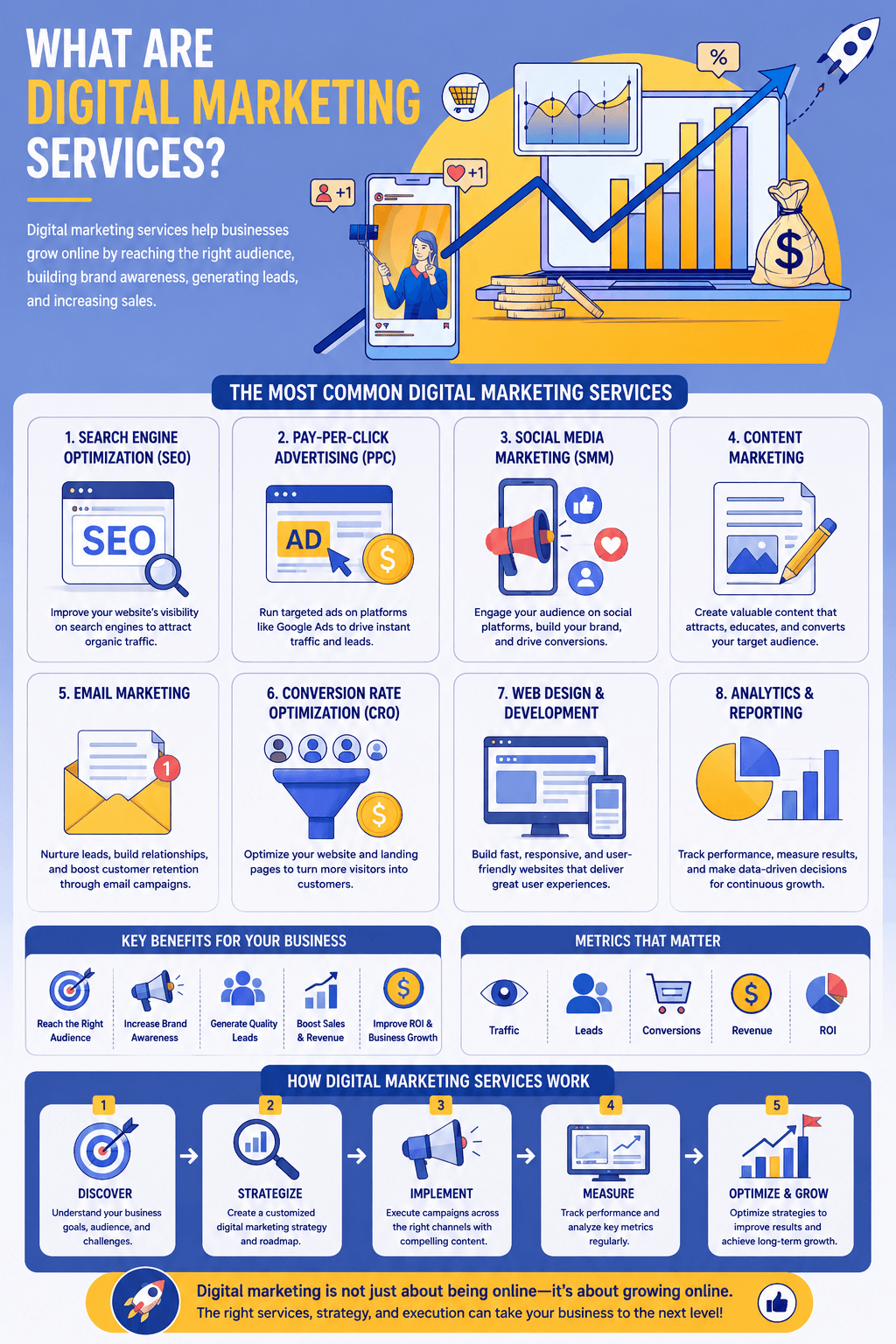
Digital marketing services are the professional work that helps a business get found online, turn visitors into leads or sales, and keep customers coming back. The usual menu includes search engine optimization (SEO), pay-per-click advertising (PPC), content marketing, social media, email marketing, web design and development, conversion rate optimization (CRO), and analytics. A growing number of providers now add AI search optimization as well, so a brand can show up inside the answers that Google’s AI features and chatbots give.
You can buy these online marketing services from an agency, a freelancer, or a consultant, or build them in house. Whoever does the work, it has to answer three questions. How do people find you when they search? Why should they choose you once they land? And can you prove the marketing paid for itself?
That last question is where most marketing falls apart. Search engines decide who appears for a query based on how they crawl, index, and rank pages, and ad platforms decide who pays what in a live auction. A good partner understands both systems and then ties the work to leads and revenue instead of a folder of screenshots.
I run SEO and content across a small network of websites, which means auditing a lot of marketing work, our own included. The problems I find most often are rarely a missing channel. They are pages nobody has updated in years, internal links pointing to the wrong place, tracking that counts page views instead of leads, and reports that look busy but never mention revenue. This guide is meant to help you avoid paying for any of those.
The short version:
- Digital marketing services cover four jobs: attracting demand (SEO, PPC, social), converting it (web design, CRO), keeping customers (email and lifecycle marketing), and measuring all of it (analytics).
- Most businesses need two or three services at first, not ten. Buy the ones that fix your biggest bottleneck.
- Management fees and ad spend are separate costs. Always ask which one a quote covers.
- Your business should own every account, domain, and data source, even when an agency runs them.
- Nobody can guarantee a number one ranking or a spot in AI answers. Treat that promise as a red flag.
Table of contents
- What counts as a digital marketing service?
- Why businesses outsource digital marketing
- Types of digital marketing services: the core list
- Digital marketing services compared: what you get and how success is measured
- SEO services: the long game that keeps paying
- AI search optimization: the newest line on the proposal
- Google Ads and PPC management: paying for attention without wasting it
- Content marketing and social media marketing services
- Email marketing services and lifecycle automation
- Web design and development as a marketing service
- Conversion rate optimization: more revenue from the same traffic
- Local SEO services and reputation management
- Analytics and reporting: where digital marketing becomes measurable
- How much do digital marketing services cost?
- Agency, freelancer, or in-house team?
- What a good digital marketing services package includes
- How to choose the right digital marketing services for your business
- What you should own before you sign anything
- Red flags when evaluating a digital marketing partner
- Where to start
- Before you hire: pricing, timelines, SEO vs PPC, and AI search
What counts as a digital marketing service?
A digital marketing service is any ongoing or project-based work that uses online channels to create demand, convert it, or keep it. In practice, the services fall into four groups:
- Demand generation brings new people to you through SEO, Google Ads and other PPC, social media, and content.
- Conversion turns those visitors into calls, leads, or orders through web design, landing pages, and CRO.
- Retention brings customers back through email marketing, lifecycle automation, and remarketing.
- Measurement tells you which of the other three is working, through analytics, tracking, and reporting.
People often mix up the service and the agency. The service is the work. An agency is one way to buy it. A full-service digital marketing agency bundles most of these jobs under one contract, while a specialist does one of them deeply. The programs that work best connect the pieces: the ads point to pages built to convert, the pages feed a CRM, and the reports show which ads produced paying customers.
Why businesses outsource digital marketing
Most companies outsource digital marketing when the stakes go up. These are the usual triggers:
- You need predictable leads, not the occasional good month.
- You are expanding into a new city, country, or product line.
- A competitor starts bidding on your brand name in Google Ads.
- Organic traffic dropped after a Google update or a site redesign, and nobody on the team knows why.
- You already pay someone, the reports look busy, and revenue has not moved.
Outsourcing also makes sense when a skill is too specialized to hire full time. A business spending $3,000 a month on ads rarely needs a full-time PPC manager. It needs a few focused hours a month from someone who has already managed many accounts like it.
Types of digital marketing services: the core list
So, what are digital marketing services in practice? Here is the digital marketing services list most agencies and freelancers work from:
- Search engine optimization (SEO), including technical, on-page, content, and local SEO
- Paid advertising, meaning PPC management for Google Ads, Microsoft Ads, and paid social
- Content marketing: articles, guides, video, and the briefs and updates behind them
- Social media marketing, organic and paid
- Email marketing and lifecycle automation
- Web design and web development
- Conversion rate optimization (CRO)
- Analytics, tracking, and performance reporting
- Local marketing and reputation management
- AI search optimization, also sold as GEO or answer engine optimization
- Strategy and campaign planning
No business needs all eleven at once. A local plumber might live on local SEO, Google Ads, and reviews. A B2B software company might lean on content, LinkedIn, email nurturing, and analytics. The sections below explain each service so you can tell which ones belong in your plan.
Digital marketing services compared: what you get and how success is measured
| Service | What is included | Best for | KPIs to track |
|---|---|---|---|
| SEO | Technical fixes, on-page optimization, content planning, link earning, local SEO | Long-term lead generation and lower acquisition costs over time | Organic traffic, rankings, conversions from organic, assisted conversions |
| Google Ads and PPC | Keyword research, campaign builds, ad copy, landing pages, bid management, negative keywords | Immediate demand capture and predictable lead flow | Cost per lead, conversion rate, ROAS, impression share |
| Content marketing | Blog strategy, topic research, content briefs, writing, updates, internal linking | Trust building and organic growth | Engaged sessions, keyword growth, assisted leads, content-driven demos |
| Social media marketing | Content calendar, creatives, community management, paid social campaigns | Awareness and demand creation, especially for visual brands | Reach, engagement, click-through rate, cost per result |
| Email marketing | Newsletters, automations, segmentation, nurture sequences, deliverability | Retention, upsells, repeat purchases, nurturing leads | Click rate, revenue per subscriber, list growth, unsubscribe and complaint rates |
| Web development | Site architecture, speed optimization, mobile UX, CMS improvements | Conversion improvements and better organic performance | Page speed, conversion rate, form completion, engagement rate |
| CRO | Landing page testing, messaging, UX improvements, funnel analysis | Getting more revenue from the same traffic | Conversion rate, lead quality, revenue per visitor |
| Analytics and reporting | GA4 setup, Tag Manager, event tracking, dashboards, attribution | Knowing what works and defending budget | Qualified leads, pipeline influenced, cost per acquisition |
| Local marketing | Google Business Profile optimization, citations, reviews, local landing pages | Service businesses and multi-location companies | Calls, direction requests, local pack visibility, review velocity |
| AI search optimization (GEO) | Answer-first content, structured data, consistent business data, earning mentions on cited sources, AI visibility tracking | Brands in research-heavy categories where buyers ask AI tools for advice | Mentions and citations in AI answers, referral traffic from AI tools, branded search growth |
| Strategy and planning | Positioning, offers, audience targeting, channel mix, monthly roadmap | Making all channels work together | Revenue targets, lead targets, channel contribution |
Look at the last column before you sign anything. Every service should report on at least one number that connects to money: leads, sales, revenue, or cost per acquisition. If a proposal lists only rankings, impressions, and followers, ask what happens to revenue.
SEO services: the long game that keeps paying
SEO is the work of earning visibility in organic search results. A complete SEO service covers technical health (can search engines crawl, render, and index your pages?), content (does each page answer what the searcher wants?), authority (do reputable sites mention and link to you?), and user experience (do people stay and act once they arrive?).
Technical problems quietly cap everything else. Slow pages, broken redirects, duplicate URLs, and pages blocked from indexing waste every dollar you spend on content. Before paying for new articles, ask for a technical SEO tune-up covering speed, mobile usability, and site structure. It is usually the cheapest SEO win available.
SEO is slower than paid ads. In competitive markets, expect months of consistent work before traffic moves. The payoff is that results compound: a page that ranks this year can still bring in leads next year without a click fee. That is why SEO tends to win once ad costs start eating your margin.
A monthly SEO retainer should produce a prioritized list of technical fixes, a content plan built around keywords with buying intent, updates to pages that are slipping, and a report that connects organic traffic to leads. If all you get is a rankings spreadsheet, you are paying for half a service.
AI search optimization: the newest line on the proposal
Search no longer ends with ten blue links. Google shows AI Overviews on many queries, and buyers increasingly ask ChatGPT, Perplexity, or Gemini for recommendations before they visit a single website.
That shift costs clicks. In a Pew Research Center analysis of real Google browsing data from 900 U.S. adults, collected in March 2025, users who saw an AI summary clicked a traditional search result in 8% of visits, compared with 15% when no summary appeared. They clicked a link inside the summary itself in only 1% of visits. Google disputed the study’s methodology, so treat the exact figures with some caution. Either way, being cited inside the answer now matters as much as ranking below it.
AI search optimization, often sold as generative engine optimization (GEO) or answer engine optimization (AEO), aims to get your brand mentioned and cited in those answers. Done properly, the work includes:
- Writing answer-first sections that state a clear definition, number, or recommendation in the first sentence or two
- Keeping your business name, services, prices, and locations consistent across your site, profiles, and directories
- Adding structured data so machines can read who you are and what you offer
- Earning mentions on the kinds of sites AI tools tend to cite, such as review platforms, industry publications, and community forums
- Tracking how often your brand appears in AI answers for the questions your buyers actually ask
Most of that is good SEO with a sharper focus on being quotable. Be careful with anyone who sells GEO as a separate, mysterious discipline or promises placement in ChatGPT. Nobody controls what a language model says, and no honest provider guarantees it.
Google Ads and PPC management: paying for attention without wasting it
Pay-per-click advertising puts you in front of people who are already searching for what you sell. It is easy to start and just as easy to burn money on. Good PPC management comes down to a handful of habits:
- Bidding on searches with buying intent, like “emergency plumber near me,” instead of research terms like “why do pipes freeze”
- Blocking searches that will never convert with negative keywords, and reviewing the search terms report weekly in the first months
- Matching the ad’s promise to the landing page headline and offer
- Tracking calls, forms, and purchases as conversions, so Google’s automated bidding optimizes for leads instead of clicks
Ask how the management fee is calculated. Some providers charge a flat monthly fee, others a percentage of ad spend, usually with a minimum. Percentage pricing can reward spending more rather than spending better, so ask what happens to the fee when the account becomes more efficient.
Content marketing and social media marketing services
Content marketing answers buyers’ questions before they ever talk to sales. The service covers topic research, briefs, writing, and editing, plus the part many providers skip: updating old posts and adding internal links so new pages get found. A content provider that only publishes and never updates will leave you with a growing archive of outdated pages.
Social media marketing is really two services that often get lumped together. Organic social builds an audience and a voice over time. Paid social on Meta, LinkedIn, TikTok, or Pinterest creates demand among people who were not searching yet, which makes it strong for visual products and new categories. Ask which one a quote includes, because the skills and the budgets are very different.
Email marketing services and lifecycle automation
Email marketing services build, segment, and mail a list of people who asked to hear from you. It is the one channel you own outright: rankings can drop and ad prices can rise, but that list stays yours. The work usually includes list growth, newsletters, segmentation, and automated sequences such as welcome series, abandoned-cart reminders, post-purchase follow-ups, and win-back emails for customers who went quiet.
Deliverability is the part buyers forget to ask about. Gmail and Yahoo require bulk senders to authenticate their sending domain and offer one-click unsubscribe, and mail that fails those checks may never reach the inbox. A capable provider sets up SPF, DKIM, and DMARC, watches bounce and complaint rates, and knows how to start reading SMTP logs to find out why messages fail when open rates suddenly collapse.
Web design and development as a marketing service
Your website is where every other service sends people, so a slow or confusing site taxes all of them. Treat it as a sales system: a clear offer at the top of the page, fast loading on mobile, an obvious next step, and pages built around the questions buyers ask.
Design and marketing work best when they are planned together, which is the argument behind Where Web Design Meets Digital Marketing: Building Brands That Convert. If you sell software, The New SaaS Homepage Brief shows how a homepage now has to hold up in screenshots, social crops, and shared links, not only when someone visits it directly.
Conversion rate optimization: more revenue from the same traffic
CRO raises the share of visitors who take action, and the math explains why it pays. If 2,000 monthly visitors convert at 2%, you get 40 leads. Lift that to 3% and you get 60 leads from the same traffic and the same ad budget.
A CRO service usually starts with analytics and session recordings to find where people drop off, then tests changes to headlines, offers, forms, trust signals, and checkout steps. Fix the basics before running formal A/B tests. Our guide to the must-have elements that turn visitors into customers covers value propositions, calls to action, social proof, and checkout friction, which is where most early gains come from.
One caution: low-traffic sites cannot run reliable A/B tests. If you get a few hundred visits a month, a good conversion rate optimization provider will recommend research-based fixes and user testing instead of split tests that never reach statistical significance.
Local SEO services and reputation management
Local SEO services help a business show up when nearby customers search, especially in Google’s map results. For service businesses, much of the demand arrives there and as phone calls rather than website visits. The work covers Google Business Profile optimization, consistent name, address, and phone details across directories, location pages, photos, and a steady flow of reviews. Reputation management adds review requests, response guidelines, and monitoring, since the way you answer a bad review is visible to every future customer.
Buyers look for local marketing help the same way their own customers look for them, by adding a place to the service they need. That is why regional agencies build their offer around searches like seo marketing idaho. Bear Fox, an agency in the Boise area, is one example: its SEO offer bundles Google Business Profile management, local listings, and review management. Sites Gallery has no commercial relationship with Bear Fox. We use it only because its service page shows the pattern clearly. When you compare local providers, ask for results in your industry and your type of market rather than national traffic charts.
Track calls, direction requests, and booked jobs coming from your Business Profile. For a local business, those numbers say more than sessions in analytics.
Analytics and reporting: where digital marketing becomes measurable
Marketing analytics is the service that makes every other service accountable. A proper setup includes Google Analytics 4 with clean conversion events, Google Tag Manager, call tracking, and a connection to your CRM so you can see which leads became customers. Without it, you are judging marketing by gut feel and the provider’s own summary.
A useful monthly report answers plain questions: how many qualified leads came in, what each one cost, which channels produced sales, and what will change next month. Watch for reports built on vanity metrics. Views, likes, and follower counts can be helpful signals, but the debate over YouTube likes vs. views vs. subscribers shows how easily a popular number distracts from the one tied to revenue.
Attribution will never be perfect. A buyer might see a social ad, search your brand a week later, and call from your Business Profile. Ask your provider which attribution model they use and how they credit channels that assist a sale without closing it.
How much do digital marketing services cost?
Digital marketing pricing depends on scope, market, and who does the work, but the pricing models themselves are fairly standard. Most providers use one of these or a mix:
| Pricing model | How it works | Common for | Watch out for |
|---|---|---|---|
| Monthly retainer | A fixed fee for an agreed set of ongoing work | SEO, content, social, full-service digital marketing | Vague scope. Get the monthly deliverables in writing. |
| Project fee | A one-time price for a defined deliverable | Website builds, audits, tracking setup, campaign launches | Change requests billed outside the original quote |
| Hourly | You pay for the time used | Consulting, training, small fixes | Unpredictable totals without a monthly cap |
| Percentage of ad spend | A share of your monthly media budget, usually with a minimum fee | PPC and paid social management | Fees that rise with spend even when results do not |
| Performance-based | Fees tied to leads, sales, or revenue | Businesses with clean tracking and a known lead value | Disputes over what counts as a qualified lead |
Two industry surveys point to similar numbers for SEO alone. Ahrefs found that 78.2% of the SEO providers it polled charge a monthly retainer, with $501 to $1,000 a month the most common range and $75 to $100 the most common hourly rate. SE Ranking’s agency survey, published in December 2024, also found $500 to $1,000 a month the most common retainer, with $50 to $100 the most common hourly range. Digital marketing packages that combine several channels cost more, and ad spend is always billed on top of the management fee.
Two habits make quotes easier to compare. First, ask every provider to separate the management fee from media spend. Second, keep the first contract short or make sure it has a clear exit clause. A digital marketing retainer that only works with a 12-month lock-in is telling you something about the provider’s confidence.
Agency, freelancer, or in-house team?
| Option | Best for | Strengths | Tradeoffs |
|---|---|---|---|
| Freelancer | One channel and a modest budget | Lower cost and direct access to the person doing the work | Limited capacity and a single point of failure |
| Specialist agency | Deep work on one channel, such as PPC or SEO | Experience across many accounts and tested processes | You still coordinate the other channels yourself |
| Full-service digital marketing agency | Several channels that must work together | One team, one plan, one report | Higher retainers and a risk of junior staff doing the work |
| In-house marketer or team | Companies where marketing drives most growth | Deep product knowledge and full-time focus | Salaries and tools add up, and no one person covers every specialty |
| Hybrid | Growing companies | An internal owner sets priorities and manages outside specialists | Someone needs time to manage vendors |
The in-house vs agency choice is less binary than it looks. The setup that works for many growing companies is one internal person who owns the strategy and the data, plus outside specialists for SEO, paid media, or design. Knowledge stays in the business, and you rent the expertise you cannot hire full time.
What a good digital marketing services package includes
Whatever you buy, a solid engagement follows a predictable shape. A typical first 90 days looks like this:
- Weeks 1 and 2: discovery calls, access to your accounts, and an audit of your website, tracking, and current campaigns.
- Weeks 2 to 4: tracking fixes and a written strategy with goals, channel priorities, budgets, and the KPIs the provider will be judged on.
- Weeks 4 to 8: campaigns launched or rebuilt, the biggest technical and conversion problems fixed, and priority pages published or updated.
- Weeks 8 to 12: a first optimization cycle based on real data, and a report comparing results with the baseline.
Ask for this plan in writing before you sign. It should name deliverables, owners, and dates. If a proposal promises growth without saying what will be done each month, there is nothing to hold anyone to.
How to choose the right digital marketing services for your business
Start with your biggest bottleneck, not the longest list of services. Use this table as a starting map:
| If this sounds like you | Start with |
|---|---|
| You need customers this month | Google Ads and a dedicated landing page |
| You get traffic but few leads | CRO and a review of your website messaging |
| Ad costs are eating your margin | SEO and content |
| Most of your leads call from nearby | Local SEO, Google Business Profile, and reviews |
| You have a customer list but few repeat sales | Email marketing and lifecycle automation |
| You cannot tell which marketing works | Analytics and tracking, before anything else |
Digital marketing services for small business owners usually start with two of these, not five. Paid search suits urgent lead needs, and understanding how paid traffic works will help you judge any PPC proposal. It is also worth testing a channel outside the screen. For some local businesses, a tracked direct mail drop beats display ads, as this direct mail vs digital ads cost comparison explains, and it gives you a clean benchmark for your digital spend.
What you should own before you sign anything
An agency can manage your accounts. It should never own them. Before work starts, confirm that each of these is registered to your business, with someone on your team as the primary admin:
- Your domain name and hosting account
- Admin access to your website and CMS
- The Google Analytics 4 property and Google Tag Manager container
- The Google Ads account and its payments profile
- Your Google Business Profile
- Your Meta business portfolio, ad accounts, and social media pages
- Your email platform, subscriber list, and CRM
- Call tracking numbers, creative files, and any content you paid for
Google Ads deserves extra attention. Google can ask an account to complete Google Ads advertiser verification, and the verified details are tied to the payments profile behind the account. If an agency runs your ads from its own account or payments profile, your campaign history and conversion data stay with the agency when you part ways. Give the agency access to an account you own, and keep billing in your company’s name.
Red flags when evaluating a digital marketing partner
- Guaranteed rankings or guaranteed AI citations. Google’s own Search Essentials guidance explains what helps pages appear and which spam practices get them demoted. Nothing in it lets an outside agency promise a position.
- Cheap link packages. Bulk links from unrelated sites can earn a penalty. Ask how links are earned, and compare the answer with how a modern link building strategy actually has to work within Google’s rules.
- Domains, ad accounts, or analytics logins held in the agency’s name instead of yours.
- Reports with no baselines, no targets, and no mention of leads or revenue.
- Long contracts with no exit terms or performance review points.
- Bought followers, likes, or reviews. They break platform rules and can get your accounts restricted.
- A senior team in the sales pitch and people you never met doing the actual work.
Questions to ask before you sign
- Who will work on my account each week, and what have they done before?
- What exactly will I receive each month?
- How will you track leads and sales, and can I see the setup?
- Which accounts and assets stay in my name?
- What are the contract length and the exit terms?
- Can you walk me through a campaign that underperformed and what you changed?
The last question tells you the most. Every provider has campaigns that missed. The good ones can explain why without blaming the client.
Where to start
Pick one bottleneck from the table above, make sure your tracking can measure it, and buy the one or two services that fix it. Review results at 90 days against your baseline before adding a channel. That approach costs less than a broad retainer, and it tells you quickly whether a provider can deliver.
Before you hire: pricing, timelines, SEO vs PPC, and AI search
Yes, when the service matches a clear goal and you can handle the leads it brings in. For most small businesses, local SEO, a well-built Google Business Profile, tightly targeted Google Ads, and a website that converts give the best return. Start with one or two services, track calls and form leads from day one, and add channels once the first ones pay for themselves.
Full-service digital marketing usually bundles strategy, SEO, PPC, content, social media, email, website support, and analytics under one retainer. Scope varies a lot between agencies, so ask for a written list of monthly deliverables, the names of the people doing the work, and confirmation that every account and file stays in your name.
It depends on the channels, the market, and who does the work. For SEO alone, surveys by Ahrefs and SE Ranking both found $500 to $1,000 a month the most common retainer, and both put the most common hourly rates between $50 and $100. Packages covering several channels cost more, and ad spend is always billed on top of the management fee.
Paid search can produce leads within days of launch once tracking and landing pages are ready. SEO and content usually need several months of consistent work before rankings and traffic move, and competitive markets take longer. Email and CRO sit in between, because they work with traffic and contacts you already have.
Neither is better in general. PPC buys visibility now and is easy to control, but the leads stop when the budget stops. SEO earns visibility that compounds over time, but it is slower. Many businesses run PPC for immediate demand while SEO builds, then shift budget toward organic as it starts producing leads.
Hire a freelancer when you need one skill done well, an agency when several channels have to work together, and an in-house marketer when marketing is central enough to justify a full-time salary. Many growing companies use a hybrid model: one internal owner who sets priorities and manages specialist freelancers or an agency.
Measure business outcomes: qualified leads, booked calls, sales, revenue, pipeline influenced, and cost per acquisition. Traffic, impressions, likes, and followers are useful diagnostics, but they are not results on their own. Agree on baselines and targets before work starts, and ask for reports that tie each channel to leads or revenue.
Ask who will do the work each week, what you will receive every month, how leads and sales are tracked, which accounts stay in your name, what the contract length and exit terms are, and how they handled a campaign that underperformed. Clear, specific answers matter more than a polished pitch deck.
More providers now offer it, usually called GEO or answer engine optimization. The work focuses on clear, quotable content, consistent business information across the web, structured data, and earning mentions on the sites AI tools cite. Treat it as an extension of good SEO, and be wary of anyone who guarantees your brand will appear in AI answers.
Start with the service that fixes your biggest bottleneck. If you need customers this month, start with Google Ads and a strong landing page. If you get traffic but few leads, start with CRO. If ad costs are eating your margin, invest in SEO and content. If you depend on calls from nearby customers, start with local SEO.
