Window Film Distributors: How Tint Shops Should Choose
Choose a window film distributor like a business owner: read spec sheets, compare dealer programs, track roll yield and price by cost per job.

Most tint shops do not lose money in the bay. They lose it at the order screen: a film bought on roll price that adds twenty minutes to every install, a core shade that goes out of stock the week you are booked solid, a spec sheet that promised heat rejection your customer never feels.
Window film distributors sit in the middle of all of that. Whether you buy wholesale window film from a regional warehouse, through a manufacturer’s dealer program, or from an online window tint supplier, the right partner keeps your core films on the shelf, publishes data you can sell honestly, ships fast enough to protect your schedule, and stands behind warranty claims. The wrong one turns every week into a supply problem.
This guide is written for working shop owners rather than procurement departments. It covers how to read a spec sheet before a price list, which manufacturers sit behind the brands you carry, how dealer programs compare with open distributors, how many cars a roll really covers, and the cost-per-job math that shows whether a cheaper film is actually cheaper.
The short version:
- Judge film by cost per completed job, not roll price. In the worked example below, a roll that is $120 cheaper ends up costing about $11 more per car.
- Compare heat rejection with TSER. IR rejection figures only mean something when the wavelength range is stated.
- LLumar, SunTek, V-KOOL and Hüper Optik all come from Eastman, so carrying two of them is a tiering decision, not a supply hedge.
- Get glass compatibility guidance in writing before filming large, insulated, or annealed panes.
- Score your distributor every quarter on fill rate, lead time, damage, claims, and spec data. Start testing alternatives when two or three lines stay weak.
Table of Contents
- Why the Distributor Matters More Than Most Tint Shops Realize
- What Professional Tint Shops Should Look For in Window Film Distributors
- The Cheapest Film Is Rarely the Most Profitable Film
- Roll Sizes, Yield, and How Much Film a Shop Really Uses
- Reading a Spec Sheet Before You Read a Price List
- What Your Distributor Should Actually Stock
- Who Makes What: Window Film Brands and the Companies Behind Them
- Choosing a Distributor Based on Your Shop Type
- Authorized Dealer Program or Open Distributor
- Signs You Are Working With the Wrong Distributor
- A Distributor Scorecard You Can Run Every Quarter
- Receiving, Storing, and Documenting Film for Warranty Claims
- What to Ask Before You Commit to a Window Film Distributor
- Marketing Only Works If Your Supply Can Keep Up
- Final Thoughts
- Spec Sheet, Dealer Program, Roll Yield and Tint Law Questions
Why the Distributor Matters More Than Most Tint Shops Realize
Shop owners spend a lot of time comparing film brands and very little comparing the companies that deliver them. That is backwards. A film brand is a promise about performance. A distributor is a promise about availability, accuracy, and support, and your customers feel it the moment that promise breaks.
When a supplier is slow, vague, or out of stock, the costs stack up quietly. Jobs get rescheduled. Staff spend afternoons chasing tracking numbers instead of installing. Cash sits in shades you over-ordered as insurance. A customer who booked ceramic gets offered “something similar,” and the review that follows never mentions the distributor by name.
A strong distributor does the opposite. Stock on your core films is predictable, product details are clear enough to reorder without guessing, orders ship when promised, and someone who understands film picks up the phone when a customer asks a question you cannot answer from memory.
Customers never see any of this. They see the finished car or window, whether you hit the appointment time, and whether the film performs the way you said it would. Consistent film, reliable stock, and accurate spec data sit behind every one of those, which is why sourcing belongs in the same conversation as your reviews, referrals, and repeat business.
What Professional Tint Shops Should Look For in Window Film Distributors
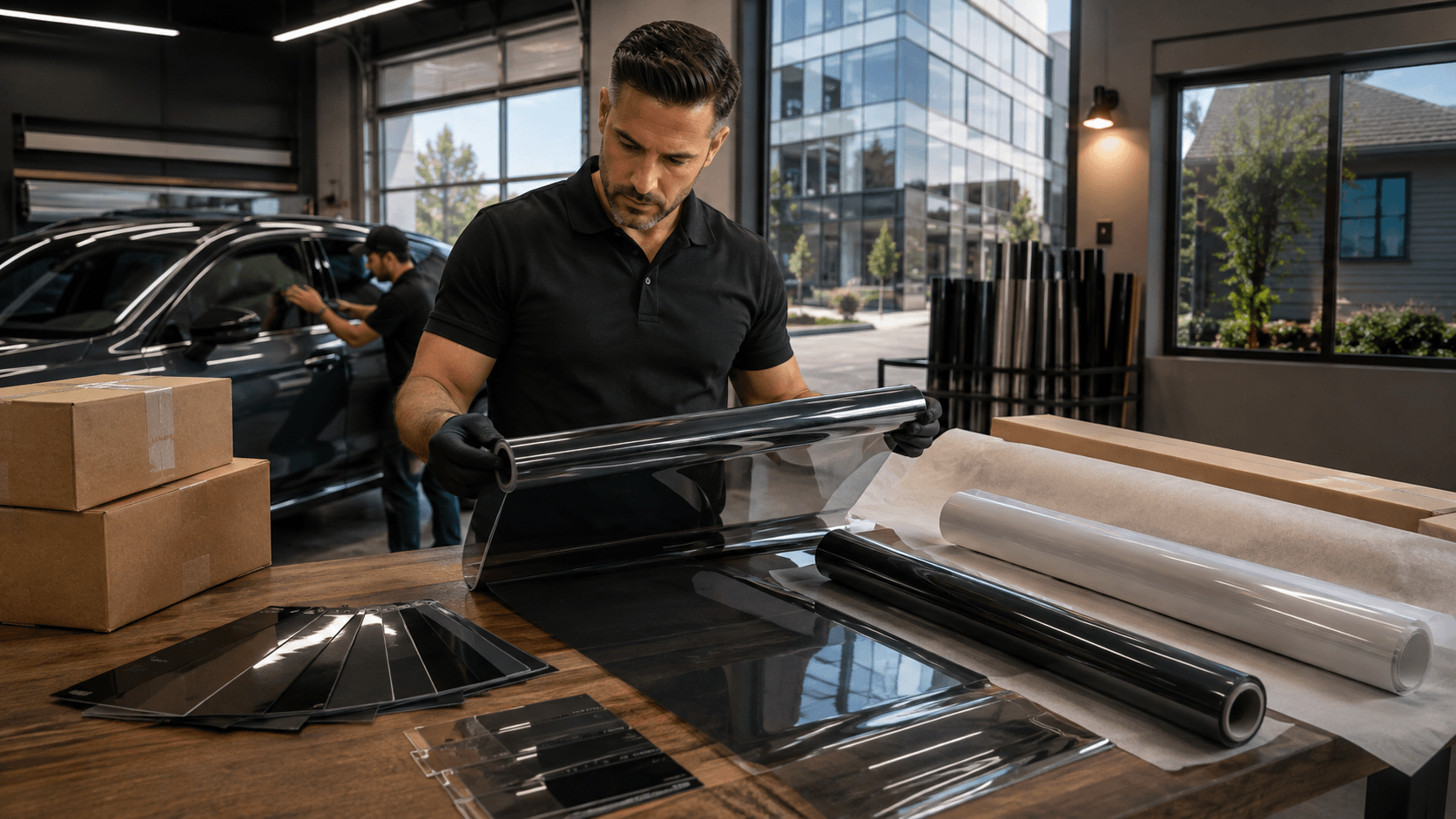
Distributors differ far more in how they serve shops than in what their catalogs look like. These ten criteria separate a supply partner from a box shipper.
| Criterion | Why it matters | What good looks like |
|---|---|---|
| Product range | Automotive, residential, and commercial jobs need different films | Core auto shades plus the flat glass categories you actually sell |
| Stock reliability | Stock-outs on core films cancel booked jobs | Live stock status and honest restock dates |
| Film consistency | Roll-to-roll variation causes shrinking problems and color mismatches | Same shade and same behavior on every reorder |
| Shipping speed | Your schedule depends on their warehouse | Predictable cutoff times and delivery windows |
| Technical support | Customers ask questions you need answered fast | Someone who understands film, not only order status |
| Pricing structure | Margin depends on landed cost, not list price | Clear trade pricing, volume tiers, and freight terms |
| Samples and sales tools | Customers buy what they can see and feel | Swatches, heat demos, and comparison sheets |
| Brand positioning | Some markets buy by brand name, others by film type | Brands that fit how your customers shop |
| Warranty support | Claims test the relationship more than orders do | Clear registration, a documented process, and fast resolution |
| Ordering experience | Reordering the same films should take minutes | Saved lists, order history, and accurate SKUs |
This table looks simple, but it can save you from expensive mistakes. Too many shops choose a distributor on one factor, usually price, and that tends to backfire within a season.
Criteria are also easier to apply than to read about. Take the supplier you buy from most and score it honestly against each row. Weak spots show up quickly, and the quarterly scorecard later in this guide turns that exercise into a habit.
How to Find Window Tint Distributors Near You
A search for window tint distributors near me often returns retail tint shops, because they far outnumber distributors. These routes work better:
- Use manufacturer dealer and distributor locators. LLumar, for example, points buyers to local LLumar or SunTek dealers and distributors, and Scorpion Window Film publishes its authorized distributors by state.
- Ask glass shops, sign shops, and wrap shops in your area who they buy film from. They have already done the vetting.
- Check whether a regional warehouse selling wholesale window tint offers will-call pickup. Collecting a roll the same morning can save a fully booked day.
- Keep a national online supplier as a second option for breadth and for specialty products you do not want to stock.

The Cheapest Film Is Rarely the Most Profitable Film
A cheap roll looks good on an invoice and bad everywhere else. Film that is harder to shrink, scratches easily, or behaves differently from roll to roll raises the real cost of every job it touches.
A film that installs faster, looks cleaner, and causes fewer callbacks often earns more than a cheaper roll, even at a higher price per foot. Buy film like a business owner, not just like an installer.
Here is the arithmetic. Roll price is one of four variables and usually the smallest.
Cost per completed job equals roll cost divided by cars per roll, plus labor hours at your loaded rate, plus your callback rate multiplied by the cost of a redo.
Yield is where cheap film quietly gets expensive. Film that shrinks unpredictably or resists heat forming produces more scrap per vehicle, and scrap never appears on an invoice. Twenty extra minutes per car on a five-car day adds up to more than a full bay hour, every working day.
Callbacks are worse, because a redo costs the film, the labor, the bay slot you cannot sell to anyone else, and some goodwill. One redo per twenty jobs is a very different business from one per hundred.
A Worked Example: Two Films, One Sedan
Two ceramic films in the same tier, installed on the same sedan. The figures are illustrative, so swap in your own.
| Film A | Film B | |
|---|---|---|
| Roll price (40 in x 100 ft) | $400 | $280 |
| Cars per roll after scrap | 7 | 6 |
| Film cost per car | $57.14 | $46.67 |
| Install time | 2 hours | 2 hours 20 minutes |
| Labor at $40 per hour, loaded | $80.00 | $93.33 |
| Callback rate | 2% | 6% |
| Expected callback cost at $200 per redo | $4.00 | $12.00 |
| Cost per completed job | $141.14 | $152.00 |
Film B is $120 cheaper per roll and about $11 more expensive per car. Across 400 cars a year, the cheap film costs roughly $4,300 in margin, before counting the reviews that callbacks tend to produce.
Run this on your own numbers before your next order: take your two most-used films, calculate scrap across ten jobs, log real install time, and count callbacks by film over the last quarter. Most shops have never measured any of the three, which is exactly why roll price feels like the deciding factor. It usually is not.
Roll Sizes, Yield, and How Much Film a Shop Really Uses
Roll width decides how much of each roll ends up on glass and how much ends up in the bin. Most window tint rolls for automotive work are sold in 100-foot lengths in widths from 20 to 40 inches, with 60-inch and 72-inch rolls for large rear glass, plotter nesting, and flat glass.
| Roll width | Typical use | Approximate vehicles per 100 ft |
|---|---|---|
| 20 in | Side windows on most cars | About 4 |
| 24 in | Side windows with a little more height | About 4.5 |
| 36 in | Most side windows plus smaller rear glass | About 7.5 |
| 40 in | Covers the height of most rear windows in one piece | About 8 |
| 60 in | Large rear glass, plotter nesting, and flat glass | About 12 |
| 72 in | Flat glass and commercial work | Varies by job |
The vehicle figures come from Flexfilm’s tint measurement guide and assume an efficient install. Real yield is usually lower. Curved rear windows, SUVs and trucks, practice pieces, and film that fights you during heat shrinking all reduce it, which is why the worked example above assumes 7 cars from a 40-inch roll rather than 8.
How you cut matters as much as the roll. The same guide puts waste at up to 20% for hand cutting and as low as 10% when patterns are nested on a plotter from wider rolls, so a plotter changes which widths make sense to buy.
Track cars per roll for every film you stock. It is the most honest quality measure you have, because it captures shrink behavior, scratch resistance, and consistency in one number, and it feeds straight into your cost per job.
Full rolls are not always the right unit, though. For specialty flat glass jobs you only see a few times a year, such as a frosted bathroom window or privacy film for one office partition, buying by the linear foot avoids a 100-foot roll that sits on the shelf for a year. Suppliers such as https://www.window-film-shop.com sell decorative, privacy, and solar films by the foot or cut to size and ship across the US, which suits that kind of one-off job. Check two things before ordering this way: that full performance data is published for the film, and whether the manufacturer’s warranty still applies when film is bought by the foot rather than through a dealer program.
Reading a Spec Sheet Before You Read a Price List
The fastest way to evaluate a distributor is to look at how it publishes performance data. Complete spec sheets signal a supplier that expects professional buyers. Selective ones signal a supplier selling to whoever asks the fewest questions.
Five numbers matter, and they do different jobs:
| Spec | What it measures | What it is good for |
|---|---|---|
| VLT (Visible Light Transmittance) | Share of visible light passing through the filmed glass | Legal compliance and appearance. The number your customer and the police both care about |
| TSER (Total Solar Energy Rejected) | Solar energy rejected across the full spectrum | The honest heat rejection figure, and the one to compare across brands |
| SHGC (Solar Heat Gain Coefficient) | Solar heat that passes through the glazing system | Architectural and commercial work, and energy calculations |
| UV rejection | Ultraviolet blocked, up to roughly 380 nm | Fade and skin protection. Most quality films sit near 99%, so it rarely separates products |
| IR rejection | Infrared rejected over a stated range | Useful only when the wavelength range is published. See below |
Here is the part most sourcing guides skip. Infrared radiation spans roughly 780 to 2,500 nanometers. A film can reject a very high share inside one narrow band and much less across the whole range, and both figures can be printed as “IR rejection.”
Manufacturer data shows how wide that gap can be. 3M’s automotive data sheets list IRR, measured over 900 to 1,000 nm, separately from IRER, measured over 780 to 2,500 nm. Avery Dennison’s product overview for its Shield IR 75 film publishes 83% selective IR rejection, 59% IRER, and 44% TSER for the same film. None of those numbers is false. They answer different questions, and only TSER answers the one your customer is asking.
Industry bodies point buyers to whole-spectrum numbers instead. The International Window Film Association’s solar control education guide presents TSER as one minus the solar heat gain coefficient, expressed as a percentage, so a higher TSER always means less solar heat gets through. The European Window Film Association technical paper on infrared measurement sets out why the full 780 to 2,500 nm range is the meaningful one for infrared and why handheld meters cannot measure it.
That has a practical consequence in your bay. The handheld IR lamp demo many shops use to sell ceramic upgrades measures a narrow slice of the spectrum, not total heat rejection. It is a persuasive demonstration. It is not a measurement of what the customer will feel.
None of this is unique to film. A spec published without its test conditions is a claim rather than a measurement, which is the same problem behind the gap between manufacturer claims and real-world tests in other product categories.
What this means when you evaluate a distributor:
- Do product pages publish TSER, or only IR rejection?
- Do they state the glass used in testing? 3M, for instance, notes that its Color Stable figures are measured on 6 mm automotive green glass. Results on one glass type do not transfer to another.
- If they publish IR rejection, do they state the wavelength range?
- Are architectural films NFRC rated, or tested to a published industry method?
- Are architectural figures center-of-glass or whole-window? The IWFA guide notes that NFRC lists whole-window values while manufacturer sheets often show center-of-glass values, so the two will not match.
A distributor that publishes complete data gives you something you can sell honestly. One that publishes a single impressive number hands you a claim you will eventually have to defend to a customer.
What Your Distributor Should Actually Stock
“Product range” means little until you break it into categories that behave differently in the bay and on the invoice.
| Film type | Construction | Trade-offs |
|---|---|---|
| Dyed | Dye layer in polyester | Cheapest and darkest for the money, weakest heat rejection, most prone to fading and color shift |
| Metalized | Metal particle layer | Strong heat rejection and durability, but can interfere with GPS, cellular, radio, and tire pressure sensors |
| Carbon | Carbon particles | No signal interference, good heat rejection, stable color, mid-tier price |
| Ceramic and nano-ceramic | Ceramic nanoparticles | Strong heat rejection even at light shades, no signal interference, higher cost, the standard upsell tier |
| Multilayer optical | Engineered multilayer stacks | Top-tier performance and clarity, premium pricing, usually tied to one manufacturer’s program |
The commercially important consequence: darkness and heat rejection are different things. A light ceramic film can outperform a dark dyed film on total heat rejection. That fact is the basis of the ceramic upsell, and it is also the claim customers most often refuse to believe. A distributor that supplies good comparison material on it is worth more than one offering a slightly better roll price.
For architectural and flat glass work, add solar control, safety and security, decorative and frost, privacy, Low-E, and anti-graffiti films to the list, but only the categories you actually sell.
Legal Shades Come First
For automotive work, build the shelf around what is legal on front side windows in your state, because that is where most citations and customer complaints start. VLT limits vary by state and by window position, and they change. Some states also count factory glass tint toward the total. North Dakota’s Highway Patrol, for example, tells drivers that factory tinting must be included when calculating total tint, which means the film’s VLT is not the car’s VLT.
Two habits protect you. Keep a VLT meter in the bay and check the finished glass, not just the box. And treat any supplier’s “legal in every state” language as marketing until you have checked it against your own state’s current rules.
Glass Compatibility Is a Supplier Question
High-absorption film on the wrong glass can crack it. Pilkington’s technical bulletin on field-applied films and coatings explains that solar control films absorb and reflect a large share of the sun’s energy, which can create critical thermal stress at the glass edge. The glass maker recommends reviewing those applications with the film supplier, advises against applying solar control film to annealed, single-glazed solar control glass, and suggests getting recommendations and assurances in writing before going ahead.
The film type matters too. The IWFA guide notes that nanoceramic films cut heat gain mainly by absorbing solar energy, and that high absorption can contribute to glass breakage. The ceramic upsell that works so well on cars is exactly the product to double-check on large or annealed architectural glass.
That makes glass compatibility a distributor question as much as an installer one. Any supplier selling architectural film should be able to provide film-to-glass compatibility charts by product and glass type, the manufacturer’s glass checklist, and a clear answer on glass breakage warranty coverage. Manufacturers set firm limits here. 3M’s glass checklist, for example, is required for single-pane glass larger than 100 square feet, double-pane glass larger than 40 square feet, reflective glass, and laminated glass, and wired, textured, or patterned glass gets no glass breakage coverage. If a supplier cannot produce this paperwork, that is a liability sitting in your inventory.
Who Makes What: Window Film Brands and the Companies Behind Them
Brand names on the shelf hide how concentrated film manufacturing really is. That matters when you think you are spreading risk across suppliers, and when a customer asks you to compare two brands that come out of the same company.
| Manufacturer | Brands you will see | How shops usually buy |
|---|---|---|
| Eastman Performance Films | LLumar, SunTek, V-KOOL, and Hüper Optik in automotive; LLumar, Vista, and EnerLogic in architectural; Gila for DIY retail | Authorized dealers and distributors |
| Saint-Gobain (Solar Gard) | Solar Gard, Panorama, Quantum, Armorcoat | Certified dealer network |
| 3M | Automotive lines such as Crystalline, Ceramic IR, and Color Stable, plus 3M building and home films | 3M authorized dealers |
| Madico | Madico automotive and architectural films | Dealers and distributors |
| Scorpion Window Film | Scorpion window films | Authorized distributors listed by state, with several buying routes for shops |
So who makes LLumar? The same company that makes SunTek: Eastman’s automotive page lists LLumar, SunTek, V-Kool, and Hüper Optik side by side. That leads to two practical points. First, if a customer asks about LLumar vs SunTek, you are comparing product tiers inside one manufacturer, not two independent supply chains. Second, carrying both is a decision about pricing and positioning rather than a hedge. If you want real supply diversity, your second line should come from a different parent, such as Saint-Gobain or 3M.
Ownership changes over time, so confirm the current picture on each manufacturer’s site before you build a program around it.
Choosing a Distributor Based on Your Shop Type
The right distributor for a two-bay startup is rarely right for a five-bay shop doing fleet work. Match the supplier to the stage you are at.
| Shop type | What to prioritize | What to watch for |
|---|---|---|
| Newer shop | Low minimums, flexible order sizes, training, and technical support | Being pushed into a large opening order or a full shade range you cannot sell yet |
| Established automotive shop | Bulk pricing, reorder speed, consistent rolls, plotter and pattern support | Price tiers that depend on volume you only reach in summer |
| Mixed residential and commercial shop | Architectural range, glass compatibility paperwork, and project quoting help | A supplier strong in auto film that treats flat glass as an afterthought |
Revisit the choice when your mix changes. A shop that adds commercial work or a second location usually outgrows the supplier that suited its first year.
Authorized Dealer Program or Open Distributor
There are two structurally different ways to buy film, and most comparisons of distributors blur them.
Authorized dealer programs are run by manufacturers. You commit to their line, and in exchange you typically get brand recognition your customers may already have, a manufacturer-backed warranty registered per installation, marketing support, sometimes pattern software access, and in some cases territory protection. The costs are minimum purchase commitments, less flexibility, and pricing you have limited leverage over.
Open distributors carry multiple brands. You get flexibility, the ability to compare lines on price, and easier movement between automotive and architectural product. You give up brand pull, and the warranty situation is usually less clean.
Neither is right in general. These questions decide it for your shop:
- Does brand recognition sell in your market? In some regions customers arrive asking for a named film. In others they ask for “ceramic.” That difference is worth real money, and it is local.
- Can you hit the minimums without dead inventory? A commitment that forces you to stock shades you do not sell is a discount that costs money.
- How does warranty registration work, and who honors it? Shops usually discover the answer during a claim rather than during procurement. Get it in writing.
- Does the program include pattern software? Plotter access and pattern libraries are often bundled with dealer programs and can be worth more than the film pricing.
- What happens if you leave? Whether existing customer warranties survive a change of supplier is a real issue, and it is rarely volunteered.
Many established shops run both: a dealer program for the premium tier they market by name, and an open distributor for volume work and flat glass. It is more to manage, and for a lot of shops it is the arrangement that actually fits how they sell.
Core, Backup, and Shelf: A Practical Supply Structure
The shops that run smoothest rarely depend on a single source for everything, and they rarely spread orders so thin that no supplier treats them as a priority account. A practical structure looks like this:
- A core distributor for the films you install every week, where volume earns you pricing and priority.
- A backup source for shortages, specialty requests, and films your core supplier does not carry.
- A shelf built around local demand. Stock the shades and categories your market actually buys, and order the rest when a job needs them.
Keep the shelf practical rather than impressive. Slow-moving inventory is cash you cannot spend on marketing, staff, or equipment.
Signs You Are Working With the Wrong Distributor
Most bad supplier relationships do not end in one disaster. They wear a shop down over months. Watch for these:
- Core films go out of stock regularly, and restock dates keep moving.
- Product descriptions are vague enough that you are never sure you are reordering the same thing.
- Orders ship late or arrive incomplete without warning.
- Support is slow, or every question turns into a sales pitch.
- Your team spends real hours each week fixing supplier problems instead of installing.
One of these is a bad week. Two or three are a pattern, and a good reason to start testing alternatives before peak season rather than during it.
A Distributor Scorecard You Can Run Every Quarter
Gut feel about a supplier is usually shaped by the last order. A simple scorecard replaces it with numbers you already have in your order history and job records. Score each line from 1 to 5 every quarter.
| Metric | How to measure it | Suggested target |
|---|---|---|
| Fill rate on core films | Order lines shipped complete divided by order lines placed | 95% or better |
| On-time delivery | Orders that arrived when promised | 9 out of 10 or better |
| Lead time | Average and worst-case days from order to door | Stable, with a worst case you can schedule around |
| Damage and defects | Rolls arriving damaged or with film defects | Fewer than 1 in 50 |
| Claim resolution | Days from reporting a problem to credit or replacement | Under two weeks |
| Spec data completeness | Share of your stocked films with TSER, VLT, and test glass published | Every film you sell |
| Price change notice | Days of warning before price increases | 30 days or more |
| Technical support | Time to a useful answer from someone who knows film | Within one business day |
The targets are starting points rather than industry standards, so adjust them to your market. What matters is the trend. A supplier slipping on two or three lines for two quarters in a row is telling you something, and the scorecard gives you specific numbers to raise with your rep before you move volume elsewhere.
Receiving, Storing, and Documenting Film for Warranty Claims
Warranty claims are where supplier relationships get tested, and most of the outcome depends on records you created months earlier.
- Inspect on arrival. Check boxes for crush damage, cores for dents or flattening, and roll edges for nicks before you sign for the delivery. Note any damage on the carrier’s paperwork and photograph it.
- Check the label against the order. Confirm the product, shade, and width match what you ordered. A wrong shade discovered at the car costs a bay slot.
- Log roll information. Record the product name, shade, and any lot or batch number on the label, plus the date the roll was opened. Tie each job record to the roll it came from.
- Store film properly. Keep rolls in their original packaging, off the floor, and away from heat, humidity, and direct sun.
- Register warranties on time. If your dealer program requires per-installation registration, make it part of job closeout rather than an end-of-month task.
Shipping belongs in the same picture. Several small orders from different suppliers each week mean more freight cost per roll and more chances for damage in transit. If your volume allows it, consolidating smaller shipments into fewer, larger ones can lower both.
What to Ask Before You Commit to a Window Film Distributor
Before placing a large opening order or signing a program agreement, ask direct questions and get the important answers in writing.
- How stable is stock on the films I will use most, and how do you tell customers about shortages?
- What are your order cutoff times and typical delivery windows to my location?
- Do you focus on professional installers, or mostly on retail buyers?
- Do you support flat glass work, including glass compatibility charts and project quoting?
- Do you publish TSER, VLT, and test glass for every film, and the wavelength range for any IR claim?
- How does warranty registration work, and who handles claims?
- How much notice do you give before price changes?
- How easy is it to reorder exactly the same product?
A distributor that answers these clearly and quickly is showing you how the relationship will work. One that dodges them is showing you that too.
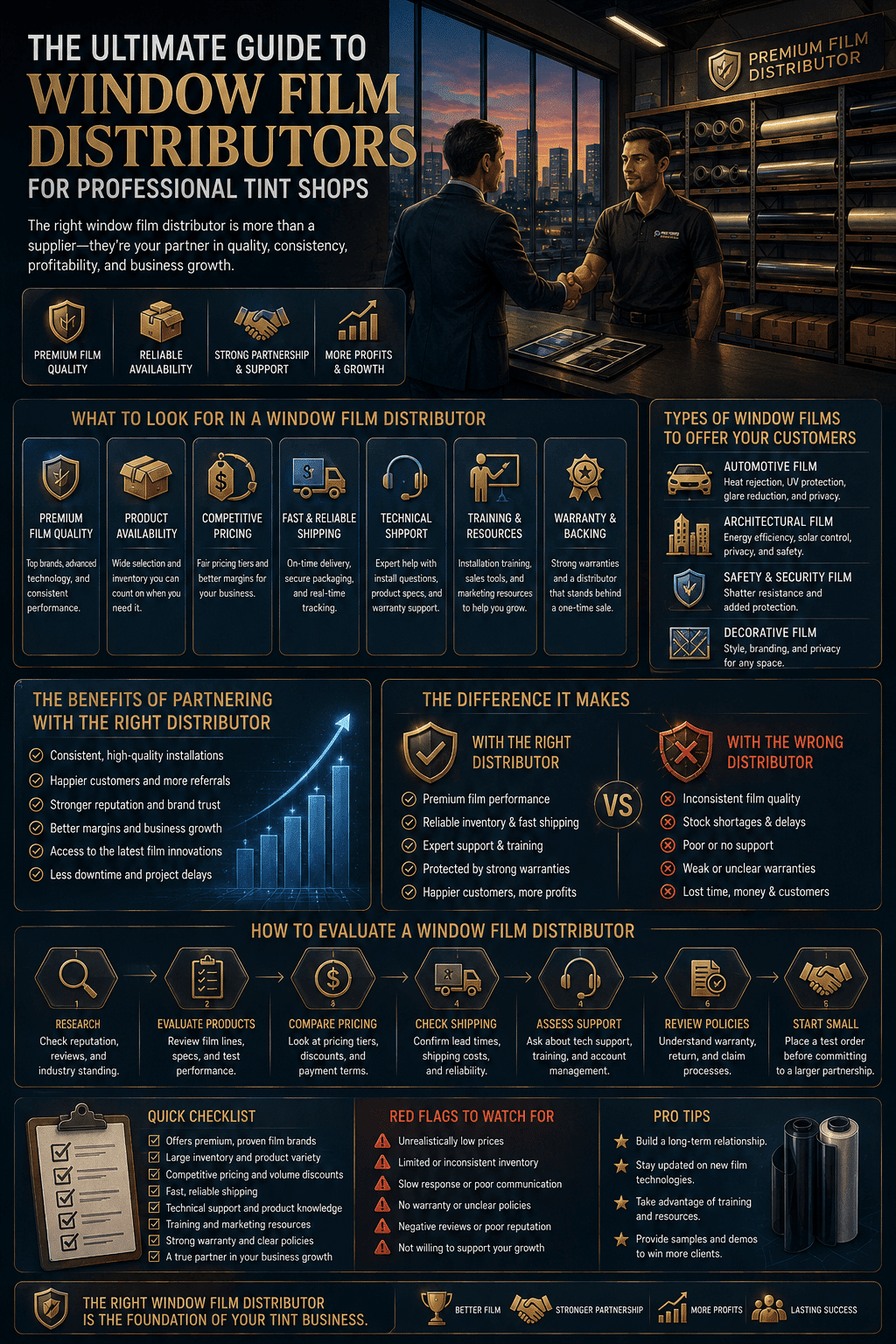
Marketing Only Works If Your Supply Can Keep Up
Local SEO, paid ads, and a strong website can fill your calendar, but marketing only converts if operations can deliver what it promises. Advertise a ceramic film you cannot reliably get, and you have paid to create disappointed customers.
Your website and your shelf should match. Feature the films you actually stock, explain tiers in plain language, and show price ranges by vehicle type and film level. Local movers face the same estimate problem, and the quote calculator approach that local service websites use translates well to tint: show a planning range up front, then confirm the exact price after seeing the vehicle.
The basics still matter more than any single tactic. Fast mobile pages, clear calls to action, real reviews, and a consistent Google Business Profile are among the design features every local business website needs, and they work best when the films and appointment times you promise online are ones your supply chain can actually deliver.
Final Thoughts
The best window film distributor is not the one with the biggest catalog or the lowest roll price. It is the one that keeps your shop profitable, efficient, and trusted: core films on the shelf, data you can sell honestly, orders that arrive when promised, and real support when a claim comes in.
So measure it. Run the cost-per-job math on your two main films, score your supplier every quarter, and read spec sheets before price lists. Shops that buy this way install better, get fewer callbacks, and earn the reviews that keep the calendar full.
How this guide was put together: it draws on the International Window Film Association’s solar control education guide, the European Window Film Association’s technical paper on infrared measurement, Pilkington’s technical bulletin on field-applied films, and published data sheets and dealer documentation from window film manufacturers. Worked examples use illustrative figures, so replace them with your own.
Editorial note: Sites Gallery has no commercial relationship with the manufacturers or suppliers named in this guide, and none paid to be included. They appear as examples so the advice can be checked against real products.
Spec Sheet, Dealer Program, Roll Yield and Tint Law Questions
A window film distributor buys film from manufacturers, holds inventory, and sells rolls, tools, and supplies to installers at trade pricing. Some are authorized for specific brands and handle that brand’s dealer program and warranty registration. Others are open, multi-brand suppliers. The best ones also provide technical support, sales tools, and help with warranty claims.
Start with stock reliability on the films you install most, then look at spec data quality, shipping speed, warranty handling, and technical support. Price comes after those, and it should be judged as cost per completed job rather than roll price, because yield, install time, and callbacks usually matter more than the invoice.
TSER stands for Total Solar Energy Rejected: the percentage of total solar energy the filmed glass rejects across the full spectrum. The IWFA presents it as one minus the solar heat gain coefficient, so a higher TSER always means less heat gets through. It is the right figure for comparing films from different manufacturers. If a spec sheet leads with IR rejection and leaves out TSER, ask for complete data before ordering.
Only when the wavelength range is stated. Infrared spans roughly 780 to 2,500 nm, and a figure measured over a narrow band can be far higher than performance across the full range. Avery Dennison’s overview for one of its films lists 83% selective IR rejection, 59% IRER, and 44% TSER for the same product. Compare TSER first.
Not necessarily. Heat rejection depends on film construction more than shade, so a light ceramic film can reject more total solar energy than a much darker dyed film. It is the most common customer misconception in tinting, and distributors that supply good comparison material make the ceramic upsell much easier.
It depends on whether brand recognition sells in your market and whether you can meet minimum purchase commitments without dead inventory. Dealer programs bring brand pull, registered warranties, and often pattern software, at the cost of flexibility and pricing leverage. Many established shops run a dealer program alongside an open distributor.
Not the distributor. A supplier’s legal label does not transfer responsibility, so the risk sits with the shop and the vehicle owner. Limits vary by state and by window position, some states count factory glass tint toward the total, and rules change. Check every film you stock against your state’s current rules and meter the finished glass.
It depends on width. Flexfilm’s measurement guide estimates about 4 vehicles from a 20-inch roll, about 8 from a 40-inch roll, and about 12 from a 60-inch roll. Real yield is lower once curved rear glass, larger vehicles, and scrap are counted, so track cars per roll for each film you stock.
Yes. Both are brands of Eastman Performance Films, which also owns V-KOOL and Hüper Optik in automotive film. For a shop, carrying LLumar and SunTek together is a tiering choice rather than a way to diversify supply. Solar Gard, owned by Saint-Gobain, and 3M are separate manufacturers.
It can, when a film absorbs a lot of solar energy and the glass is not suited to it. Thermal stress at the glass edge is the risk, and annealed glass is more vulnerable than heat-treated glass. Ask your supplier for film-to-glass compatibility charts and the manufacturer’s glass checklist before filming large, insulated, or Low-E units. 3M, for example, requires its checklist for single-pane glass over 100 square feet and double-pane glass over 40 square feet.
