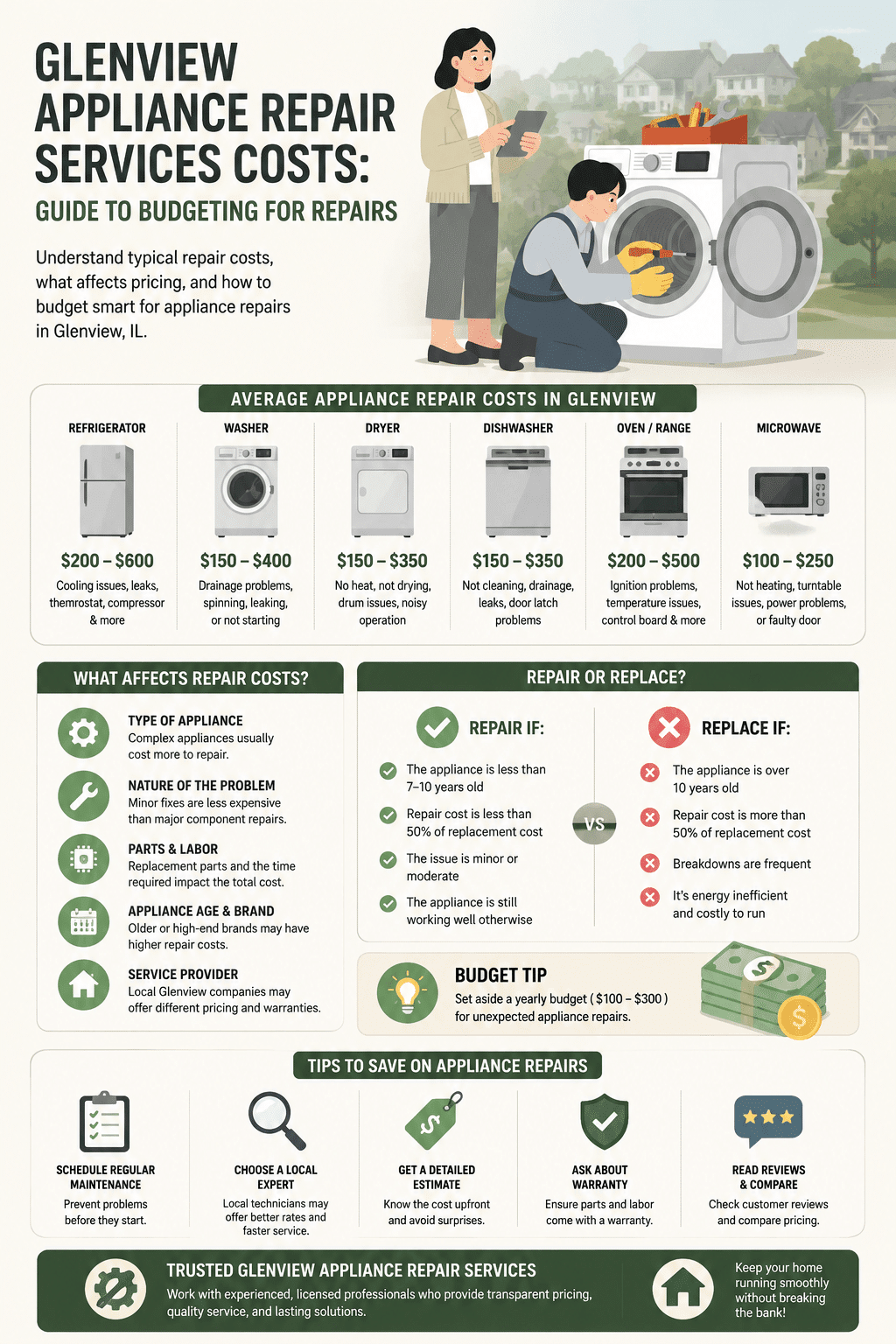
Glenview Appliance Repair Costs: A Homeowner’s Guide to Budgeting for Repairs
Real Glenview appliance repair prices, what the service call fee covers, and a simple rule for deciding whether to repair or replace.
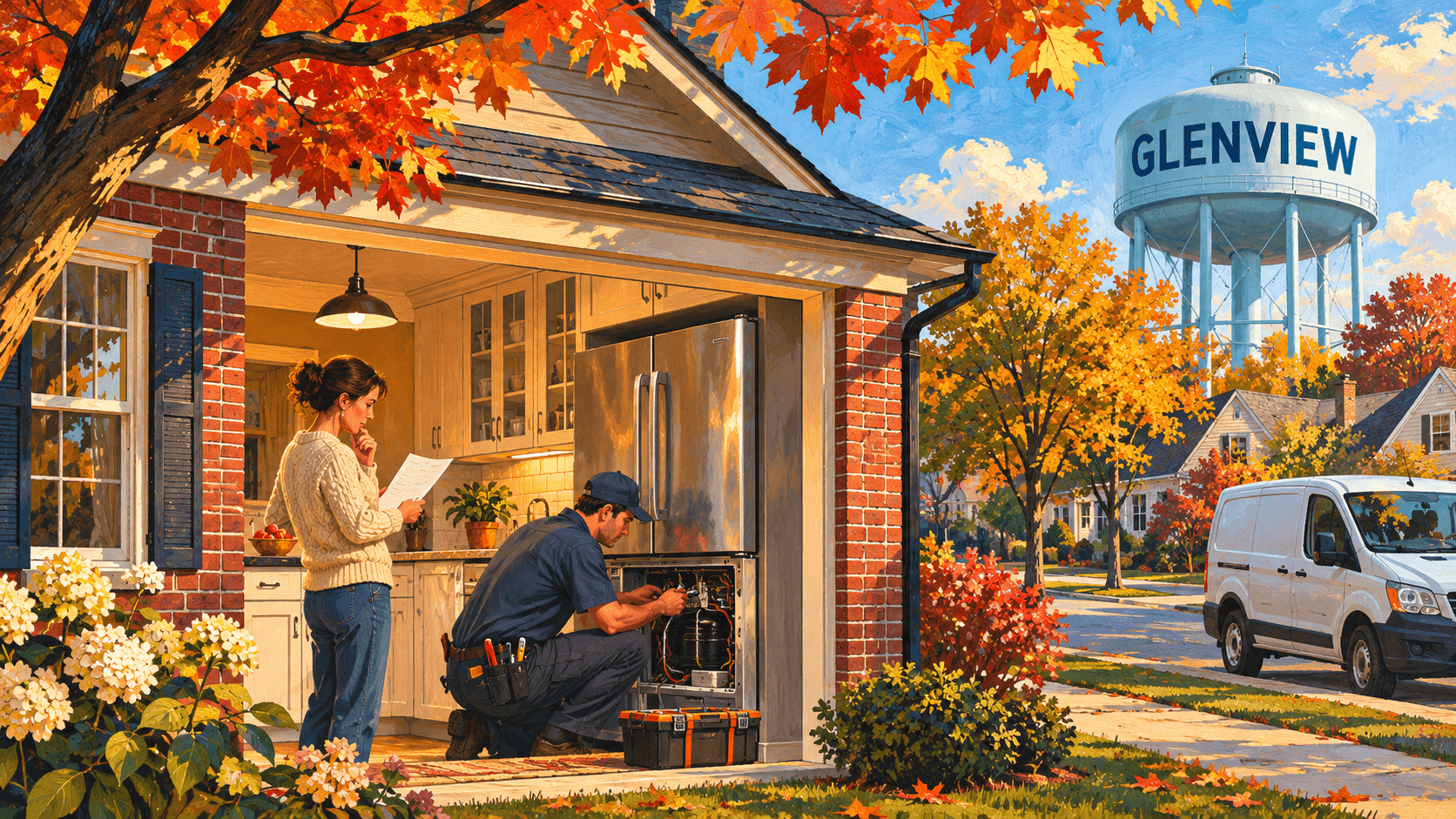
When the fridge quits on a Friday night or the washer stops mid-cycle with a full load inside, the first question in most Glenview homes isn’t “what broke?” It’s “what is this going to cost me?” This guide answers that with real numbers: what appliance repair typically costs in Glenview, IL, what the service call fee actually covers, where the big price jumps happen, and how to decide whether a repair is worth paying for at all.
The good news is that most local repairs cost less than people expect, and Angi’s Glenview appliance repair cost data backs that up, with an average job near $174. The expensive surprises come from a short list of specific jobs: sealed-system refrigerator work, electronic control boards, and premium built-in brands that need factory parts. If you know which group your problem falls into before the technician arrives, you can budget for it instead of reacting to it.
Quick answer: Most Glenview appliance repairs cost between about $114 and $224, according to Angi’s local data. A standard service call or diagnostic fee runs roughly $70 to $130 and is often credited toward the repair, while evening or weekend emergency visits can cost $140 to $400. Repairs that need pricier parts, like a washer pump or a dishwasher control board, often reach $300 to $450. Refrigerator compressor or refrigerant repairs commonly run $700 to $1,250 or more, and that is where the repair or replace decision gets real.
Table of contents
- What Goes Into a Glenview Appliance Repair Bill
- Appliance Repair Cost Ranges in Glenview by Appliance
- What Common Appliance Problems Cost to Fix
- Why Glenview Repair Bills Can Run Higher Than National Averages
- Is Same-Day or Emergency Appliance Repair Worth the Extra Cost?
- Four Free Checks Before You Pay for a Repair
- Home Warranties and Extended Plans: Do They Lower the Bill?
- Repair or Replace? A Practical Rule for Glenview Homeowners
- Why Refrigerator Repair Costs Can Jump
- Habits That Cut Your Appliance Repair Costs
- How to Vet an Appliance Repair Company in Glenview
- How to Compare Appliance Repair Quotes Without Getting Burned
- How to Budget for Appliance Repairs
- What Glenview Homeowners Ask About Repair Fees, Garage Fridges and Hard Water
What Goes Into a Glenview Appliance Repair Bill
Every appliance repair invoice is built from the same four pieces. Knowing them makes quotes much easier to compare, because two companies can reach a similar total in very different ways.
The service call or diagnostic fee
This pays for the trip and the time it takes to find the fault. HomeGuide’s national cost research puts a standard service call at $70 to $130, and emergency or after-hours visits at $140 to $400. Many Glenview-area companies credit the fee toward the repair if you approve the work on the spot. Some don’t. Ask before you book, because that one answer can move the final bill by $100.
The diagnostic fee generally covers travel, a visual inspection, basic electrical testing or the appliance’s built-in diagnostic mode, and a quote. It usually does not cover parts, the repair itself, or a return visit if a part has to be ordered.
Labor
Most technicians quote a flat rate per job, though some bill by the hour. National labor rates sit around $50 to $125 an hour. Expect Glenview and nearby North Shore suburbs such as Northbrook, Wilmette, and Northfield to land in the upper half of that range, since local operating costs and drive times run higher than in much of the country.
Parts
Parts are where totals swing the most. A dryer belt or thermal fuse is cheap, while a refrigerator control board can cost several hundred dollars on its own. You’ll usually be offered OEM parts, made by or for the original manufacturer, or aftermarket equivalents. OEM parts cost more but fit and last as designed. Aftermarket parts are often fine for simple components like belts, rollers, and fuses, and riskier for electronics.
Add-ons that quietly raise the total
- Same-day, evening, or weekend service.
- A second trip when the part isn’t on the truck.
- Hard access, like a stacked washer and dryer in a tight closet or a built-in fridge that has to be pulled from cabinetry.
- Haul-away of the old unit if the visit ends in a replacement.
Appliance Repair Cost Ranges in Glenview by Appliance
The ranges below are what most Glenview homeowners should expect to pay in total, parts and labor included, for the most common repairs. Treat them as budgeting numbers, not quotes. The last column is the useful one: it shows what usually pushes a bill to the top of the range or past it.
| Appliance | Common repairs | Typical total | What pushes it higher |
|---|---|---|---|
| Refrigerator | Defrost heater or thermostat, evaporator fan, ice maker, water inlet valve | $150 to $500 | Sealed-system work (compressor, refrigerant leak) at $700 to $1,250+; built-in brands |
| Freezer | Thermostat, defrost parts, door gasket | $150 to $450 | Sealed-system repairs; units kept in cold garages |
| Washer | Drain pump, lid switch or door lock, inlet valve, belt | $150 to $450 | Tub bearings and seals, control boards, front-load spider arm failures |
| Dryer | Belt, idler pulley, thermal fuse, heating element, gas igniter | $100 to $350 | Gas valve coils, control boards, clogged or damaged vents |
| Dishwasher | Drain pump, inlet valve, door latch, heating element | $150 to $400 | Control boards, leaks that damaged flooring or cabinets |
| Oven or range | Igniter, bake element, temperature sensor, burner | $150 to $350 | Control boards ($200 to $600), cracked glass cooktops ($250 to $600) |
| Over-the-range microwave | Door switch, diode, magnetron | $100 to $300 | Past this point, replacement is often cheaper |
| Garbage disposal | Jam, reset, leak at the sink flange | $100 to $250 | A cracked housing usually means replacement |
How these ranges were built: we started from the national figures in HomeGuide’s and Angi’s appliance cost guides, checked them against Angi’s Glenview data for local service jobs, and nudged most ranges upward to reflect North Shore labor rates. They describe what typical jobs cost, not what any single company will charge. If a quote lands well outside a range, that is your cue to ask why.
What Common Appliance Problems Cost to Fix
Nobody searches for “evaporator fan replacement.” People search for what they see: a fridge that’s warm, a dryer that won’t heat, a dishwasher full of standing water. Here is what those problems usually cost to fix in Glenview, plus the free check worth doing before you call anyone.
| What you notice | Usual cause | Typical cost to fix | Free check first |
|---|---|---|---|
| Fridge warm, freezer still cold | Evaporator fan, defrost heater or thermostat | $150 to $400 | Clear blocked vents inside the freezer and vacuum the condenser coils |
| Fridge and freezer both warm | Condenser fan or start relay, sometimes the sealed system | $150 to $350, or $700 to $1,250+ for sealed-system work | Confirm power and temperature settings, then listen for the compressor |
| Ice maker stopped making ice | Water inlet valve, ice maker module, frozen fill tube | $100 to $250 | Make sure the shutoff arm is down and the water line valve is open |
| Washer won’t drain or spin | Drain pump, lid switch or door lock, a clog | $150 to $350 | Clean the pump filter on front-loaders and look for a sock in the drain path |
| Washer leaking | Door boot gasket, fill hoses, pump seal | $120 to $350 | Tighten the hose connections and check the hoses for bulges or cracks |
| Loud banging or roaring on spin | Tub bearings, suspension rods or springs | $350 or more | Level the machine and rebalance the load |
| Dryer runs but won’t heat | Heating element or thermal fuse (electric), igniter or gas valve coils (gas) | $120 to $300 | Reset the breaker fully, since an electric dryer can tumble without heat on a half-tripped breaker, and clean the vent |
| Dryer won’t tumble | Belt, idler pulley, drum rollers | $100 to $250 | Make sure the door switch clicks when you close the door |
| Dishwasher not draining | Drain pump, clogged filter or air gap | $120 to $300 | Clean the filter and run the garbage disposal |
| Dishwasher not cleaning or drying | Wash pump, heating element, mineral scale | $150 to $400 | Clean the spray arms, add rinse aid, and run a descaling cycle |
| Oven won’t heat | Bake element, igniter, temperature sensor | $150 to $350 | Check that a delay start or Sabbath mode isn’t set |
| Gas burner clicks but won’t light | Wet or dirty igniter, misaligned burner cap, spark module | $100 to $250 | Dry the burner and reseat the cap |
| Cracked glass cooktop | Glass top replacement | $250 to $600 | Stop using it until it’s replaced |
Why Glenview Repair Bills Can Run Higher Than National Averages
National cost guides are a fair starting point, but a few things about Glenview homes push bills in a specific direction. Some you can plan for. One you can avoid entirely.
Premium and built-in kitchens
Built-in and pro-style appliances are common in North Shore remodels, and they change the math. Repairs on Sub-Zero, Wolf, Miele, Gaggenau, and other luxury appliance brands cost more for three reasons: the parts are pricier, fewer technicians are factory-trained on them, and parts are often ordered rather than pulled from the truck. That last point matters for budgeting, because it can mean two visits and several days without the appliance. When you call, give the brand and model number up front and ask whether the technician is authorized for that brand. A cheaper generalist who can’t finish the job ends up costing more.
Lake Michigan water and mineral scale
According to the Village of Glenview, the village buys most of its water from Wilmette, which draws it from Lake Michigan. Lake Michigan water is moderately hard, around 7 to 9 grains per gallon. That isn’t extreme, but over years of daily use it leaves scale on dishwasher heating elements and spray arms, on washer and ice maker inlet valve screens, and inside refrigerator water lines. The service calls it causes, like a dishwasher that stops drying well or an ice maker that slowly stops filling, are cheaper to prevent than to fix. Use rinse aid, clean the dishwasher filter monthly, run a descaling cycle a few times a year, and replace the fridge water filter on schedule.
Cold winters and garage refrigerators
A second fridge or chest freezer in an unheated garage is common around Glenview. Most standard refrigerators are built for indoor temperatures, so when the garage drops well below freezing, the thermostat in the fresh-food section rarely asks for cooling, the compressor barely runs, and the freezer side warms up. Nothing is broken, which means paying for a repair visit won’t solve it. A model rated for garage use, or moving the unit indoors for the coldest months, will.
National chains versus local independents
Both national service companies and local independent technicians work in Glenview, and they price differently. Chains often charge higher service fees but have wider parts networks and manufacturer warranty ties. Independents frequently advertise lower diagnostic fees, sometimes waived if you hire them, and can be quicker for common brands. Neither is automatically cheaper. Compare the all-in quote, not the service fee.
Is Same-Day or Emergency Appliance Repair Worth the Extra Cost?
An evening, weekend, or same-day emergency visit can cost two to three times a standard service call. Sometimes that money is well spent. Other times, waiting until the next business day costs you nothing.
Pay for same-day service when a full refrigerator or freezer has stopped cooling, or water is actively leaking onto floors or into a finished basement. If you smell gas near a range, cooktop, or dryer, don’t call a repair company first: leave the house and call 911 or your gas utility from outside.
Wait for a scheduled visit when the oven quits but the cooktop still works, the dryer runs without heat, the dishwasher won’t drain, or the ice maker stops. These are inconvenient, not urgent.
Buy yourself time. FoodSafety.gov’s power outage guidance applies to a dead fridge too: a closed refrigerator keeps food safe for up to about 4 hours, a full freezer for about 48 hours, and a half-full freezer for about 24. Keep the doors shut, move perishables into a cooler with ice, and for any leak, close the water supply valve behind the appliance. That often turns an emergency call into a cheaper next-morning appointment.
Four Free Checks Before You Pay for a Repair
Some of the cheapest repairs are the ones you never pay for. Run through these before you book a technician.
- Search for a recall. Look up your brand and model in the U.S. Consumer Product Safety Commission recall database. When a recall’s remedy is a repair, the manufacturer pays for it, and across CPSC recalls from the past five years, a free repair was the remedy in roughly a quarter of cases. If your problem matches the recalled defect, a bill of a few hundred dollars can become a free visit.
- Check every warranty you might have. Manufacturer coverage typically runs a year on parts and labor, and many refrigerators carry longer coverage on the sealed system, so check before you pay for compressor work. Also look at the credit card you bought the appliance with, since some cards extend manufacturer warranties, and at any retailer protection plan you may have forgotten about.
- Rule out the free fixes. Check the breaker and any GFCI outlet, make sure the water supply valve is fully open, clean the dishwasher filter, clear the dryer lint screen and vent, and look for a control lock or child lock on the display. Our cooktop repair checklist walks through the same pre-call routine for ranges and cooktops, and most of it applies to other appliances too.
- Document the problem. Photograph the model and serial number tag, write down any error code, and record a short video of the noise or leak. Technicians diagnose faster with this, and some can tell you over the phone which part to bring, which can save a second trip charge.
Home Warranties and Extended Plans: Do They Lower the Bill?
A home warranty trades unpredictable repair bills for a fixed monthly cost plus a fee per visit. Most plans run about $30 to $100 a month, with service fees of roughly $75 to $150 each time a technician comes out. Whether that saves money depends entirely on how many claims you’ll actually make.
Here’s the math on a plan at $60 a month with a $100 service fee. That’s $720 a year before anything breaks. One $250 dryer repair that year means you paid $820 for something that would have cost $250 out of pocket. But if a 12-year-old fridge needs a $1,100 sealed-system repair and the plan approves it, you come out ahead.
Before signing, read three parts of the contract closely: the coverage cap per appliance, exclusions for “improper maintenance” or pre-existing problems, and whether you can choose your technician. Most plans assign a contracted company, and some cap or exclude premium built-in brands, which matters if your kitchen has them.
Single-appliance extended plans from a retailer or manufacturer often cost $100 to $300 depending on the appliance. Before buying one, confirm that it includes in-home labor, that it covers electronics and the sealed system, and who performs the work.
Repair or Replace? A Practical Rule for Glenview Homeowners
The most useful rule of thumb is the 50 percent rule: if a repair costs more than about half the price of a comparable new appliance, and the appliance is past the 10-year mark, replacing it usually makes more sense. HomeGuide applies the same two tests.
| Your situation | Usually the better move |
|---|---|
| Under about 7 years old, repair under 50% of a new model | Repair |
| Under about 7 years old, repair over 50% of a new model | Check every warranty first, then compare |
| Over 10 years old, repair under 50% of a new model | Depends on energy use and how often it has failed before |
| Over 10 years old, repair over 50% of a new model | Replace |
Example one: a 4-year-old front-load washer needs a $280 drain pump, and say a comparable new washer costs about $1,000. That’s 28 percent on a young machine. Repair it.
Example two: an 11-year-old French-door refrigerator needs a $1,050 sealed-system repair, and a comparable new model costs about $2,200. The repair is under half, but the fridge is past 10 years, sealed-system fixes on older units are less predictable, and a newer model will use less electricity. This one leans toward replacement.
When energy use tips the decision
For older refrigerators and freezers, electricity belongs in the math, because you pay it every month the unit runs. If you’re retiring a working second fridge or freezer instead of repairing it, ComEd has long run a Fridge and Freezer Recycling program that picks up old, working units for free and pays a small incentive. Check ComEd’s site for the current amount and eligibility before you pay anyone to haul it away. And if you’re planning bigger energy upgrades, such as solar or a home energy management system, unplugging an inefficient garage fridge is one of the cheapest first steps.
Why Refrigerator Repair Costs Can Jump
Refrigerator repairs split into two very different jobs, and knowing which one you’re facing changes the budget by several hundred dollars.
Component repairs: about $150 to $500
Defrost heaters and thermostats, evaporator and condenser fans, ice makers, water valves, door gaskets, and control boards. Typical signs are frost building up on the back wall of the freezer, a fan that is noisy or silent, water on the floor, or an ice maker that stopped working. If the part is common, these are usually fixed in one visit.
Sealed-system repairs: about $700 to $1,250 or more
This means the compressor, the refrigerant lines, and the coils that carry refrigerant. Signs include both compartments warming at the same time, a compressor that runs constantly or clicks on and off without cooling, or oily residue near the lines. These jobs open the refrigerant circuit, which under federal Clean Air Act rules requires a technician with EPA Section 608 certification. Ask for it. Then check whether your manufacturer covers the sealed system beyond its standard warranty before you approve the work.
Habits That Cut Your Appliance Repair Costs
You don’t need to be handy to avoid the most common service calls. A few habits handle most of them.
- Vacuum the refrigerator condenser coils once or twice a year, more often if you have pets. Dirty coils make the compressor run longer and hotter.
- Clean the dishwasher filter monthly and keep rinse aid topped up, which also helps with spotting from hard water.
- Empty the dryer lint screen after every load and have the full vent run cleaned at least once a year. Lint buildup is a known dryer fire risk, not just a cause of slow drying.
- On front-load washers, wipe the door gasket and leave the door open between loads. Swap rubber fill hoses for braided steel ones every five years or so.
- Don’t overload washers or dryers. Overloading wears out bearings, belts, and suspension parts, which are among the pricier washer repairs.
- Call early. A squeal, a slow drain, or a fridge running warmer than usual is cheaper to fix now than after it fails completely.
The same thinking applies to the rest of the house. If you’re doing seasonal checks anyway, make sure your HVAC fan motor is in good working order before the season starts, since that’s another repair that costs far less when it’s caught early.
How to Vet an Appliance Repair Company in Glenview
Illinois doesn’t require a state license for general appliance repair, so the checks below do the job a license would.
- General liability insurance. Ask for a certificate of insurance. Manufacturer service networks and home warranty companies typically require one, so a company that can’t produce it is a red flag.
- EPA Section 608 certification for any job that opens a refrigerant system.
- Gas experience for gas ranges, cooktops, and dryers, including a leak check once the repair is done.
- Factory authorization if you own a premium or built-in brand.
- A written repair warranty. Ask how many days the labor and the part are guaranteed, and get the answer on the invoice.
- Review patterns, not star averages. Read the two- and three-star reviews, see how the company responds, and check BBB complaints for disputes that were never resolved.
How to Compare Appliance Repair Quotes Without Getting Burned
Two quotes can look very different and still describe the same job. Put them side by side using the same five questions:
- What is the total estimated range, parts and labor included?
- Is the service call fee credited if I approve the repair?
- How long is the warranty on the labor and on the part?
- Are you using OEM or aftermarket parts?
- If the part has to be ordered, is the return visit included?
Be cautious with a quote far below everyone else’s, a company that won’t put the estimate in writing, pressure to replace the appliance on the spot, or a demand for full payment before the part arrives.
It also helps to get at least one quote from a local independent alongside a national service company, since their pricing models differ. If you want a Glenview-area independent to compare against, mannyappliances.com is one option. Ask them the same five questions you’d ask anyone else.
Editorial note: we have no commercial relationship with this company. It is mentioned only as a local example to compare quotes against, and it did not supply or review the cost figures in this guide.
How to Budget for Appliance Repairs
Single repairs feel random, but across a whole kitchen and laundry room they are fairly predictable. A simple plan:
- List your major appliances with their ages.
- Set aside enough for one mid-range repair a year, roughly $200 to $350 at Glenview prices.
- For anything past 10 years old, start a replacement fund. Divide the price of a comparable new model by the years you expect the old one to keep going, and save that amount each year.
- If you can wait a day, book a scheduled visit. It costs less than an evening or weekend emergency call.
- Keep a single note of every repair: date, part, cost, and company. When the same appliance shows up twice in two years, it’s usually time to replace it.
What Glenview Homeowners Ask About Repair Fees, Garage Fridges and Hard Water
Angi’s Glenview data puts the typical appliance repair job at about $114 to $224, with an average near $174. Repairs that need pricier parts, like a washer pump or a dishwasher control board, often reach $300 to $450, and sealed-system refrigerator work commonly runs $700 to $1,250 or more.
A standard visit typically costs $70 to $130, and emergency, evening, or weekend visits can run $140 to $400. Many local companies credit the fee toward the repair if you approve the work that day. Ask before you book, and ask whether the credit still applies if a part has to be ordered and the technician comes back.
If the freezer is still cold, the cause is usually an evaporator fan or a defrost part, which typically costs $150 to $400 to fix. If both sections are warm and the compressor runs constantly or keeps clicking, it may be a sealed-system problem at $700 to $1,250 or more.
Use the 50 percent rule. If the repair costs less than half the price of a comparable new fridge and the fault is a component like a fan, defrost part, or valve, repairing usually makes sense. A sealed-system repair on a fridge past 10 years is usually better spent on a replacement.
The parts cost more, fewer technicians are factory-trained on them, and parts are often ordered rather than carried on the truck, which can mean a second visit. Ask whether the technician is authorized for your brand before booking.
Only if you file enough claims. At $60 a month plus a $100 service fee, you pay $720 a year before anything breaks, so one small repair costs more under the plan than out of pocket. Plans tend to pay off when you have several aging appliances or one expensive failure that the contract actually covers.
Most standard refrigerators are designed for indoor temperatures. When a Glenview garage drops below freezing, the thermostat rarely calls for cooling and the freezer side warms up. It is usually not a broken part. A garage-rated model or moving the unit indoors for winter solves it.
Glenview uses treated Lake Michigan water, which is moderately hard. Over time it leaves scale on heating elements, inlet valve screens, and ice maker lines. Rinse aid, monthly filter cleaning, and a descaling cycle a few times a year prevent most of the related service calls.
Yes, if your problem matches a recall whose remedy is a repair. Search your brand and model in the CPSC recall database before you book a paid visit, and contact the manufacturer listed on the recall notice.
Compare it with the ranges in this guide and with at least one other quote. Ask for the all-in total, whether the service fee is credited, how long the repair is guaranteed, and whether parts are OEM. A quote far below the rest, or one the company will not put in writing, deserves caution.
Glenview Appliance Repair Costs at a Glance