From Yachts to Kayaks: Choosing Perfect Boat for Your Journey
Yacht, catamaran, sailboat or kayak? Match the boat to your trip length, crew and skill, with typical rental prices and the safety gear each needs.

Choosing the right boat for a journey is mostly a question about the journey. How far are you going, for how many days, with how many people, and how much of the work do you want to do yourself? A kayak, a pontoon, a catamaran and a crewed yacht all float, but they answer those questions in very different ways. Pick the wrong one and the mistake rarely shows up on the first outing. It shows up a season later, as a boat sitting unused at the marina.
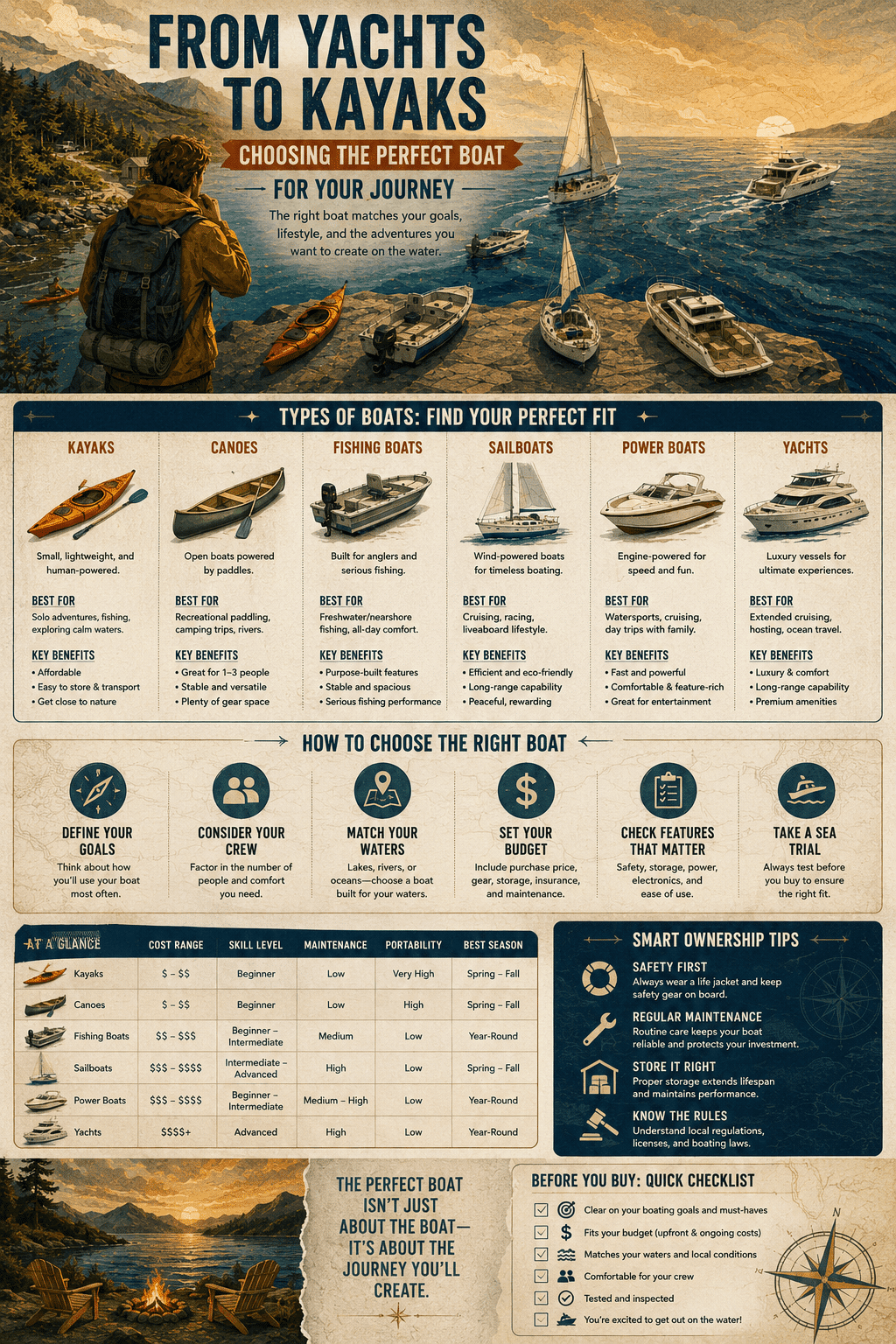
This guide compares the main types of boats for travel: kayaks and canoes, motorboats and pontoons, sailboats, catamarans, trawlers, yachts, and the license-free canal boats that many first-timers overlook. For each one you’ll see who it suits, what it takes to operate, what renting or chartering typically costs, and the safety gear you’re expected to carry, so you can pick the right boat for your trip before spending any money.
The Short Answer: Which Boat for Which Trip
To choose a boat, match it to the trip: how exposed the water is, how many days you’ll spend aboard, how many people are coming, how much of the work you want to do, and your total budget. These picks cover the most common cases:
- Day trips with family and no experience: rent a pontoon or a small bowrider. Both are stable, simple to drive and forgiving of beginner mistakes.
- A week of island hopping with friends: book a catamaran with a skipper. You get stability, deck space and someone who knows the anchorages.
- Learning a skill you’ll keep for life: take a sailing course, then charter a small sailboat for a weekend.
- Slow travel with no boating license: hire a self-drive canal boat in France, the UK or Ireland.
- Remote lakes and rivers on a small budget: a canoe if you’re hauling camping gear, a kayak if you want speed and better control in wind.
- Living aboard or covering long distances: a trawler or a bluewater sailboat, but only after real time on the water.
Table of contents
- The Short Answer: Which Boat for Which Trip
- Start With the Trip, Not the Boat
- Types of Boats Compared at a Glance
- Yachts: Space, Range and More to Manage
- Catamarans and Trawlers: Stability for Longer Trips
- Sailboats: Hands-On Travel on the Wind
- Motorboats and Pontoons: The Easiest Start
- Kayaks and Canoes: Closest to the Water
- Canal Boats and Houseboats: Boat Travel Without a License
- What Each Type of Boat Actually Costs
- Rent, Charter, Join a Club or Buy
- Mistakes First-Time Renters and Buyers Make
- Safety Equipment Every Boat Needs
- Choosing What Fits You
- How This Guide Was Researched
- Boat Rental Prices, Licenses and Beginner Boats: Quick Answers
Start With the Trip, Not the Boat
Before comparing hulls, get honest answers to five questions. They narrow the field faster than any brochure.
- How far, and how exposed? Sheltered lakes, rivers and canals forgive almost anything. Open coastal water and crossings between islands call for a seaworthy boat and a skipper who can read the weather.
- How long? A two-hour outing needs a seat and a cooler. A week aboard needs berths, a toilet, a galley, water tanks and storage you won’t hate by day three.
- How many people? Every extra person adds weight, luggage and the need for some privacy. A boat that feels roomy for two can feel cramped for four.
- How much do you want to do? Some travelers want to steer, trim sails and plan routes. Others want to swim, read and arrive. Both are fine, and they lead to different boats.
- What’s the real budget? Not only the rental or purchase price, but fuel, marina fees, insurance and the gear you’ll need on board.
Sometimes the honest answer to question four is that you want to be at sea without being responsible for anything. That’s a perfectly good answer, and it points to a cruise rather than a boat you operate yourself. The LuxuryCruiseTickets.com showcase in our gallery shows how ocean, river and expedition cruises are packaged for travelers who want the crew to handle everything.
Types of Boats Compared at a Glance
The table compares the most common types of boats for travel on the points that decide most choices: what each one does best, who it suits, how much skill it takes to start, and what renting usually costs. Prices are typical US ranges and move a lot with season, location and boat size.
| Boat type | Best for | Who it suits | Skill to start | Typical rental cost |
|---|---|---|---|---|
| Kayak | Solo exploring, calm water, light multi-day trips | 1 or 2 people | Low, a short lesson is enough | $10 to $30 per hour |
| Canoe | River trips, carrying camping gear | 1 to 3 people | Low | $10 to $30 per hour |
| Pontoon boat | Lakes, family days, swimming and fishing | Families and groups (check the capacity plate) | Low | $75 to $300 per hour |
| Motorboat (bowrider, center console) | Fast day trips, fishing, water sports | Small groups (check the capacity plate) | Low to moderate | $75 to $300 per hour |
| Small sailboat | Learning to sail, short coastal hops | 1 to 4 people | Moderate, a course helps | From about $25 per hour for a daysailer |
| Catamaran | Island hopping, groups, people prone to seasickness | Groups and families | Moderate, or hire a skipper | About $1,000 to $2,000 for a half day with a group |
| Trawler | Slow, long-range cruising and living aboard | Couples and small families | Moderate to high | Usually chartered by the week, prices vary by region |
| Crewed yacht | Comfort, privacy and range with no work | Groups who want full service | None, the crew runs the boat | About $29,000 to $35,000 per week for a small crewed sailing yacht in peak season |
| Canal boat or houseboat | Slow inland travel, villages, no license | Couples to large families | Low, with a briefing on departure | Weekly hire, prices vary by region and season |
Yachts: Space, Range and More to Manage
Yachts, sail or motor, are built for comfort and range. Even a modest one usually has separate cabins, a galley, a head with a shower and a saloon where everyone can sit out of the sun or rain. That makes a yacht the closest thing to a floating home, and it’s why yachts suit longer coastal trips where you want to move every day without giving up a proper bed.
The trade-off is complexity. Larger yachts are harder to dock, especially in wind or current, and they carry more systems to maintain: generators, watermakers, electronics and plumbing. Marinas charge by length, so every extra foot costs money every night. Most people experience a yacht through a crewed charter first, where a captain and often a cook handle all of that, long before they think about owning one.
Storage matters more than people expect. Even on a large boat, space disappears once you add luggage, food, water toys and spare parts. Decide where everything lives before you leave the dock, and keep the walkways around the deck clear.
Catamarans and Trawlers: Stability for Longer Trips
Catamarans sit on two hulls, which gives them a wide, stable platform. They heel far less than a single-hull sailboat, so drinks stay on the table and people who get seasick usually cope better. The big deck and the cabins in each hull give a group more privacy, which is why catamarans are so common in charter fleets in island destinations.
In the catamaran vs monohull debate, two caveats get less attention than they should. A catamaran’s width means many marinas charge extra for a slip, and some small harbors have no room for one at all. And while a catamaran feels easier, handling one well still takes training, especially when docking in a crosswind.
If you’re moving from chartering toward owning, talk to a multihull specialist rather than a general broker. The website of UK specialist Robert Underwood Multihulls, one of the sites in our gallery, shows what that kind of service usually covers: buying advice, maintenance and upgrades, and help selling the boat later.
Trawlers are the opposite of fast. Their displacement hulls push through the water instead of planing over it, usually at single-digit speeds in knots, and in return they burn little fuel and can travel long distances. Inside they feel like small apartments, with standing headroom and big windows. Couples who want to spend months on a coastline, or on a long inland route such as America’s Great Loop, often end up on a trawler.
Sailboats: Hands-On Travel on the Wind
Smaller sailboats are for people who want to take part. You trim sails, read the wind, plan around tides and weather, and you get better every trip. That’s the appeal: the journey is the activity, not just the way to reach a beach.
The wind is free, so fuel costs stay low, but your schedule belongs to the weather. A planned four-hour passage can take seven if the breeze dies, or need postponing if it builds. Space is tight on smaller boats, so pack soft bags instead of suitcases and keep loose gear stowed. On a sailboat, clutter is a safety problem as well as a comfort one.
If you plan a bareboat charter, where you sail the boat yourself with no skipper, expect the company to ask for proof of competence. A recognized certificate such as an RYA Day Skipper or an ASA bareboat certification, or a detailed sailing resume, is the usual requirement. A week-long course is the fastest way to get there, and it makes every later trip safer and cheaper.
Motorboats and Pontoons: The Easiest Start
Motorboats are the easiest way into boating. You steer, work the throttle and go. They’re quick to learn, fast enough to cover real distance in a day, and they don’t depend on the wind, which makes them good for day trips, fishing and water sports. The cost is fuel, which adds up quickly at planing speed compared with a sailboat.
Pontoon boats deserve their own mention, because they’re one of the most common answers to the question of the best boat for beginners, especially for families on lakes. They sit on two or three aluminum tubes, they’re very stable, and the open deck with sofa-style seating feels like a floating patio. They’re not built for rough open water, but on calm lakes and rivers they’re hard to beat.
Two smaller options round out the powerboat family. Inflatable boats and RIBs (rigid inflatable boats) are light, very stable for their size and easy to trailer or stow, which is why they’re the standard tender for larger yachts. Personal watercraft, often called jet skis, are a fast way to have fun on the water but a poor choice for actual travel, since there’s no shelter and almost no storage, and many US states set minimum operator ages and require a boating education card.
One habit worth building early: treat published range and fuel-burn figures as best-case numbers. They’re usually measured on a lightly loaded boat in flat water, and a full load of people, fuel and gear cuts them noticeably. It’s the same gap between the spec sheet and real use that our guide to checking spec sheets against real-world tests walks through with electric scooters, and the method carries over: note the conditions, measure, compare. Many skippers also follow the rule of thirds for fuel, using a third to get out, a third to get back and keeping a third in reserve.
Kayaks and Canoes: Closest to the Water
At the minimalist end are kayaks and canoes. They put you right at water level, quiet enough to drift close to wildlife, and they reach shallow creeks and coves no motorboat can get into. They’re also the cheapest way onto the water, and casual paddling needs no license in most places.
Kayak vs canoe comes down to how you travel. A kayak uses a double-bladed paddle and a low seated position, so it’s faster, tracks straighter and handles wind and small waves more easily. A canoe uses a single-bladed paddle and an open hull that swallows camping gear, coolers and even a dog, which is why it’s still the classic choice for multi-day river trips with portages.
Stand-up paddleboards belong in the same family. In the US, the Coast Guard treats a paddleboard used outside a swimming, surfing or bathing area as a vessel, so the same life jacket rule applies, along with a whistle and, after dark, a light. Boards are great for short outings on calm water, but they carry almost nothing, so they rarely work as a travel boat on their own.
Packing is the hard limit. Everything has to fit in dry bags, the weight has to be balanced, and you carry all of it on a portage. Paddlecraft also leave you more exposed to cold water and weather than any other boat in this guide, so a life jacket you actually wear matters most here.
Expedition paddling takes all of this to an extreme. The Yukon 1000, a self-supported paddle race of about a thousand miles from Whitehorse toward the Arctic, is featured in our gallery and gives a sense of what long-distance canoe and kayak travel demands in navigation, food planning and stamina. Few people will ever race it, but it’s a good reminder that a small boat can be a serious travel vessel when the plan matches the paddler’s skill.
Canal Boats and Houseboats: Boat Travel Without a License
Canal boats are the most overlooked option for boat travel, and for many first-timers the easiest. Self-drive hire boats on European waterways are built for beginners: slow, flat-bottomed and fitted out like small holiday homes, with cabins, a kitchen and a shower.
The big draw is licensing. Le Boat, one of the largest operators, rents self-drive boats in France, the UK, Ireland, Germany, Italy, Belgium, the Netherlands and Canada, and its guide to boating without a licence confirms you don’t need a permanent boating license to drive them. Instead, the base team gives you a handling briefing before departure and arranges any temporary permit the route requires. The boats top out at around 10 to 12 km/h, which sounds slow until you realize the point is to moor at a village for lunch, cycle to a market and move on when you feel like it.
France’s Canal du Midi, a UNESCO World Heritage Site, is the classic first route, and hire boats range from compact two-berth cruisers to boats that sleep twelve. The skills to learn are working through locks and mooring, and both come quickly with a patient crew.
Houseboat vacations on large lakes follow a similar idea: low speeds, simple controls and the boat as your accommodation. Licensing rules differ by country and state, so confirm them with the rental company before you book.
What Each Type of Boat Actually Costs
Cost is usually what narrows the decision, and boat rental costs vary more between boat types than almost anything else.
At the rental end, kayaks, canoes and paddleboards typically cost $10 to $30 per hour, and Lake.com’s breakdown of boat rental costs puts most pontoons, fishing boats and speedboats at roughly $75 to $300 per hour. A half-day catamaran rental for a larger group often lands around $1,000 to $2,000. Sailboats cover the widest spread: a small daysailer can rent for about $25 an hour, while an analysis of over 2,500 yacht listings found small crewed sailing yachts average $29,000 to $35,000 per week in peak season. Bareboat charters typically start around $5,000 to $7,500 per week for a 32 to 45-foot boat outside peak season.
Yacht charter costs rarely stop at the base rate. Crewed charters often add an advance provisioning allowance on top to cover fuel, food and port fees, plus a customary crew tip, and bareboat charters usually require a security deposit. Ask for a full estimate before comparing two quotes.
The cost of owning a boat works differently. The purchase price is only the entry fee: insurance, a slip or storage, maintenance, winterizing, fuel and repairs arrive every year whether the boat leaves the dock or not. A common rule of thumb, which boats.com’s guide to the cost of owning a boat also uses, is to budget around 10 percent of the boat’s value each year for maintenance, and most owners end up planning for 15 to 25 percent once everything else is included. Older boats often run higher, because aging systems need replacing. A trailerable boat kept at home or in dry storage cuts the biggest recurring cost, the slip, as long as you have a vehicle rated to tow it. A modest boat you use every weekend is usually a better decision than a bigger one that sits at the marina most of the season.
Rent, Charter, Join a Club or Buy
Ownership is only one way in, and rarely the best first step. Renting by the hour or day costs the least and shows you what you enjoy. A charter, bareboat or with a skipper, lets you live with a specific boat type for a week, including the parts brochures skip: sleeping aboard, cooking in a small galley and dealing with weather.
Boat clubs sit in between. Members usually pay a joining fee and monthly dues for access to a shared fleet, and the club handles maintenance, insurance and storage. They suit people who go out often but don’t want the upkeep, though popular weekends can book up fast.
Check boating license rules before you commit to any option. They vary by country, state and province, and often by boat size and engine power. In the US, most states require at least some operators to carry a boating education card, usually based on age or birth year, and bareboat charter companies around the world commonly ask for a recognized qualification or a documented sailing resume before handing over the keys.
Outside the US, bareboat charter companies in much of Europe ask for an International Certificate of Competence (ICC) or an equivalent national license, and UK sailors usually get theirs through the RYA. The rules change from one country to the next, so check them for your charter destination before you book flights.
Mistakes First-Time Renters and Buyers Make
Most bad boat experiences trace back to a handful of avoidable decisions:
- Buying for the dream voyage instead of the usual weekend. Choose for the trips you’ll take most often, and charter for the rare big one.
- Ignoring the capacity plate. Most single-hull motorboats under 20 feet carry a plate showing the maximum number of people and weight, and overloading is one of the easiest ways to swamp a small boat.
- Forgetting the logistics around the boat. A trailer boat needs a vehicle rated to tow it and a launch ramp nearby. A slip can mean a waiting list, a contract and proof of insurance.
- Skipping the survey and sea trial. Have any used boat inspected by an accredited marine surveyor, and test it in conditions close to the ones you’ll actually face.
- Not reading the weather and cancellation policy. Policies differ between operators, and many reschedule weather-cancelled trips instead of refunding them.
Safety Equipment Every Boat Needs
Whatever boat you choose, the safety basics come first, and the numbers explain why. In its 2024 Recreational Boating Statistics report, the U.S. Coast Guard recorded 556 recreational boating deaths, the fewest since it started keeping records more than 50 years ago. Roughly three-quarters of the victims drowned, and 87 percent of drowning victims were not wearing a life jacket. About 70 percent of deaths happened on boats whose operator had never received boating safety instruction.
In practice, US federal life jacket requirements and the other basics come down to this:
- A properly fitted, Coast Guard-approved wearable life jacket for every person aboard, kayaks and paddleboards included. Children under 13 must wear one while a recreational boat is underway unless they’re below deck or in an enclosed cabin, and some states set their own age.
- A throwable flotation device on boats 16 feet and longer (canoes and kayaks are exempt), stowed where someone can grab it fast.
- A whistle or horn on every boat, and visual distress signals for most boats on coastal waters and the Great Lakes.
- A fire extinguisher on most motorboats, checked and in date.
- The engine cut-off switch lanyard attached to the driver. On boats under 26 feet that have one installed, federal law requires it whenever you’re running on plane.
- For trips offshore or out of cell coverage, a VHF radio and a float plan left with someone ashore.
Life jackets come in several types, from foam vests to inflatable belt packs, and not every type suits every activity or age. The BoatUS Foundation explains how the types and labels work, and it’s worth reading before you buy or rent one.
Beyond the gear, the Coast Guard’s own advice is short: take a boating safety course, get a free vessel safety check, look at the weather and water conditions before leaving, and don’t boat under the influence. Alcohol is still the leading known factor in fatal boating accidents.
Gear Worth Adding Beyond the Legal Minimum
The legal list keeps you compliant. A few more items keep a trip running smoothly, and they depend on the boat. Motorboats and sailboats benefit from good dock lines and fenders, an anchor sized for the boat with enough rode for at least five times the water depth, a manual bilge pump as a backup, and a small spares kit with fuses, a fuel filter and a spare impeller. Paddlers need dry bags, a bilge sponge or hand pump, and a paddle leash.
Two tests are worth applying to every piece: will it survive salt water, and can it do more than one job? Storage is limited on anything smaller than a yacht, so single-purpose gadgets rarely earn their space. For a boat you’ve just bought, or one you charter often enough to bring your own kit, a specialist range of Boat Accessories sorted by category, such as deck hardware, mooring and anchoring, and spare parts, is easier to compare than scattered listings on general marketplaces.
Choosing What Fits You
No boat is best in general. The right one matches how far you go, how long you stay out, who comes with you and how involved you want to be. A crewed yacht and a canoe can both give you a perfect week. They just give you very different weeks.
The cheapest way to find out is to rent or charter before you buy. Spend a day on a pontoon, a weekend on a small sailboat, a week on a canal boat. The boat you keep wanting to go back to is your answer, and it may not be the one you expected when you started reading.
How This Guide Was Researched
Rental and charter prices are typical US ranges drawn from published rental guides and charter listings, including the rental cost breakdown and yacht listing analysis cited above. They change with season, region and boat size, so treat them as a starting point for budgeting rather than a quote. Safety figures come from the U.S. Coast Guard’s annual boating statistics, and the equipment list reflects US federal rules, which states and other countries can add to. Canal boat licensing details are based on operator information and differ by country. Links to showcase pages point to websites featured in the Sites Gallery collection and are included as relevant examples, not endorsements. Sites Gallery has no commercial arrangement with the marine retailer linked in the gear section, or with any charter operator or rental platform named in this guide.
Boat Rental Prices, Licenses and Beginner Boats: Quick Answers
For most beginners on calm water, a pontoon boat or a small motorboat such as a bowrider is the easiest start. Both are stable, simple to drive and easy to rent. If you would rather paddle, a sit-on-top kayak is the most forgiving. Sailing is very learnable, but a short course before your first charter makes a big difference.
Renting a kayak or canoe, which typically costs $10 to $30 per hour. Casual, non-motorized paddling generally needs no license, though you still need a life jacket.
It depends on size, crew and season. Small crewed sailing yachts average roughly $29,000 to $35,000 per week in peak season, while a bareboat sailing yacht of 32 to 45 feet can start around $5,000 to $7,500 per week outside peak season. Crewed charters often add a provisioning allowance and a crew tip on top of the base rate.
It depends on where you are, the boat’s size and engine power, and whether you rent with a skipper. Most US states require some operators to hold a boating education card, and bareboat charter companies usually ask for a recognized qualification. In much of Europe, bareboat charters usually require an International Certificate of Competence (ICC) or an equivalent license. Self-drive canal boats in France, the UK and several other countries can be hired without a permanent license after a briefing from the operator.
A catamaran is usually more comfortable for beginners because its two hulls keep it stable and level, which also helps with seasickness. A monohull is often cheaper to charter and teaches the feel of sailing faster, but it heels more and asks more of a first-time crew.
Rent or charter first. It is the lowest-risk way to learn which boat type fits your trips before you take on insurance, storage, maintenance and fuel costs that continue whether or not the boat leaves the dock.
Yachts, sail or motor, prioritize comfort, speed and range. Trawlers prioritize fuel efficiency and long-range cruising at slow displacement speeds, and their roomy interiors suit couples who spend weeks or months aboard.
